
Stories from the ward
Every sprint of this product began with one thing that goes wrong in a hospital. Here is what went wrong, and what the system now does about it.
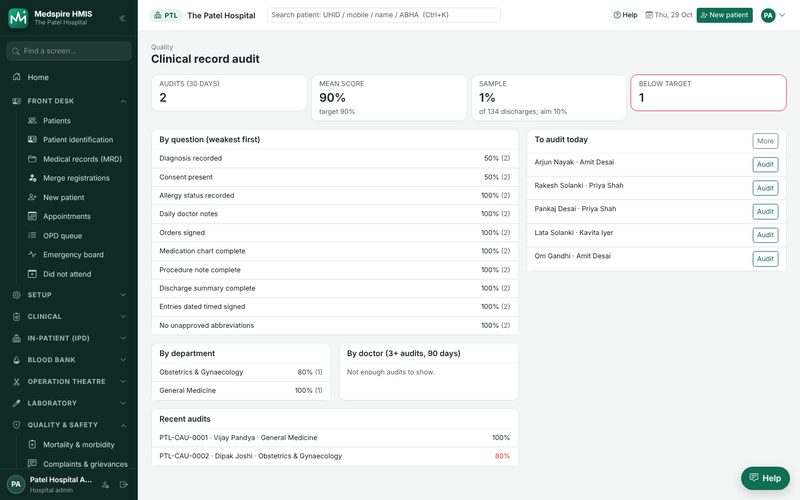
Clinical record audit
Chart audits that are only done on the charts that look good. Every day the screen draws a repeatable sample of recent discharges; a doctor who did no…
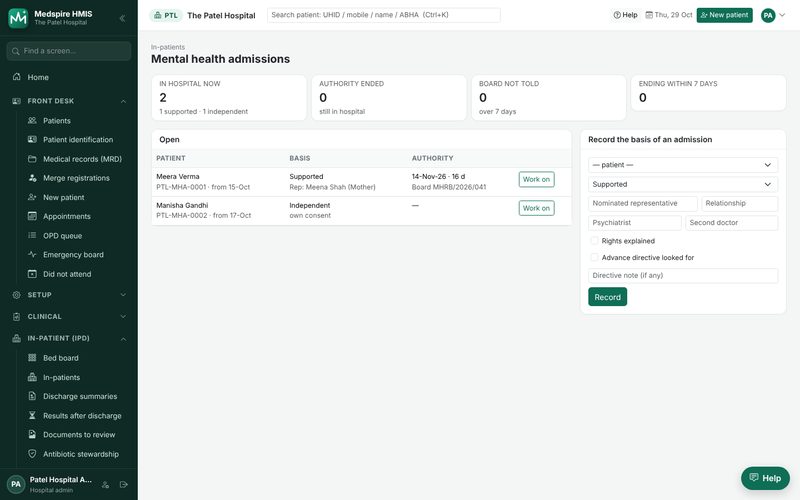
Mental health admissions
A supported admission that outlives its authority. The screen records whether the patient consented themselves or through a named representative with…
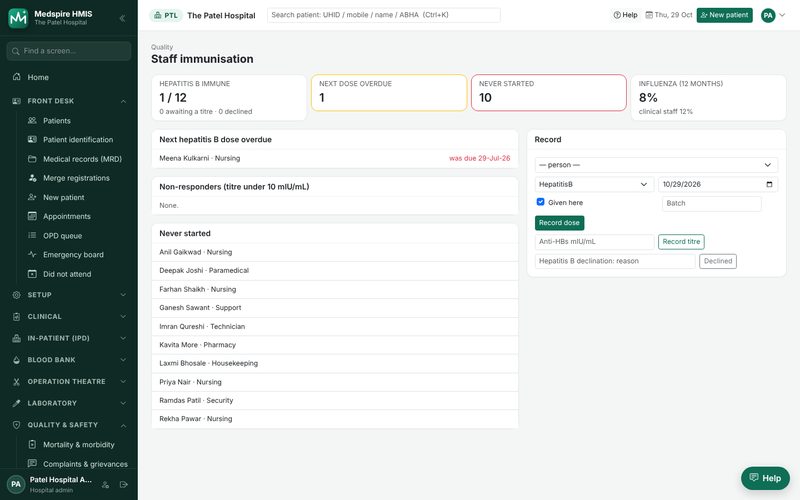
Staff immunisation
The hepatitis B course that stops after the second dose. Each member of staff has a schedule with the minimum gaps between doses, a titre check after…
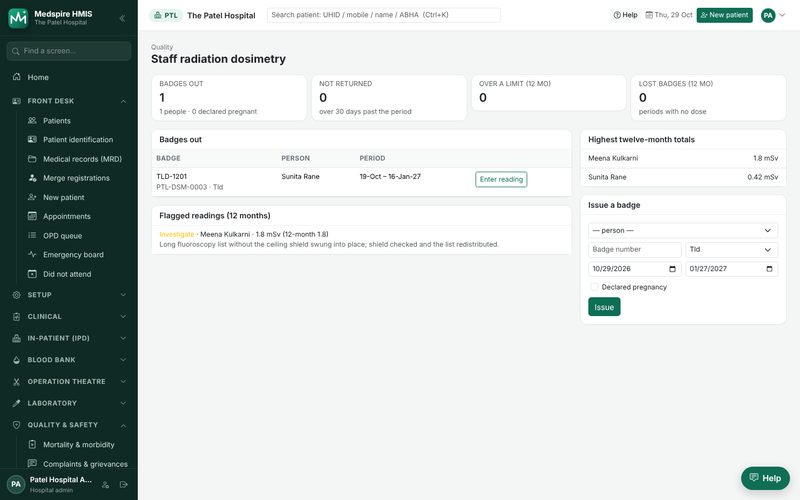
Radiation dosimetry
The dosimeter badge that is never collected, or a reading that nobody adds up. Badges are issued per person and period, overdue badges are listed, rea…
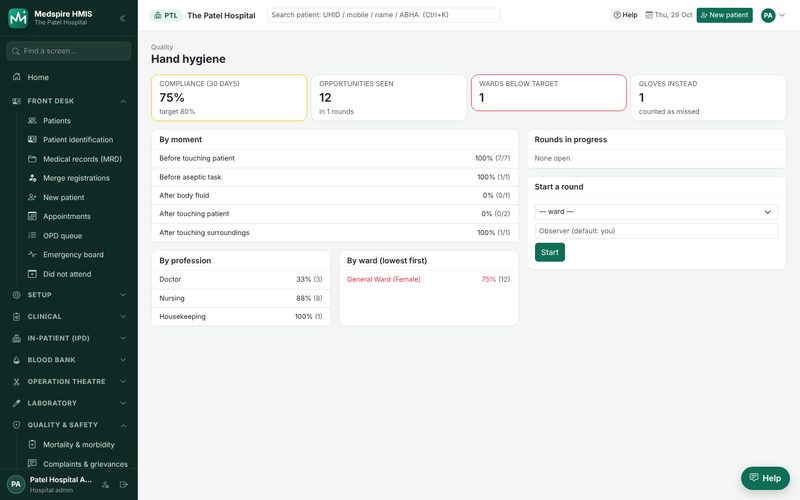
Hand hygiene
Hand hygiene audits that are one person's guess on a good day. Observers record what they see at the five WHO moments by ward and profession, never by…
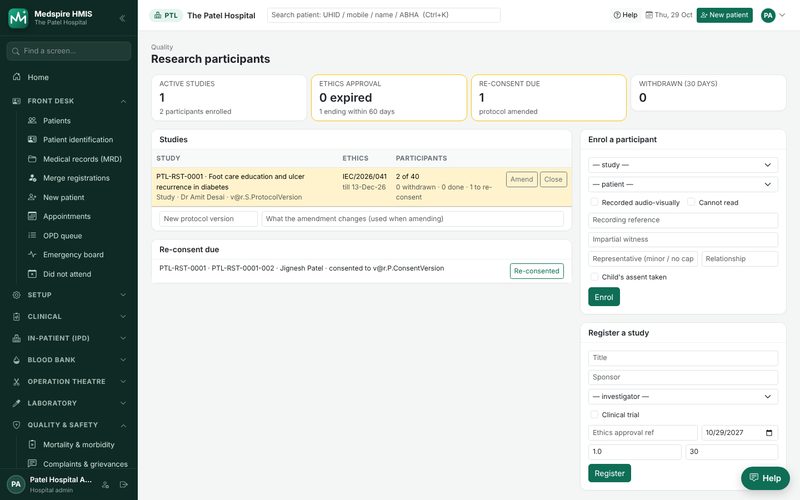
Research participants
A trial participant enrolled without a valid ethics approval, or in two trials at once. A study needs an ethics reference in date (and a registry numb…
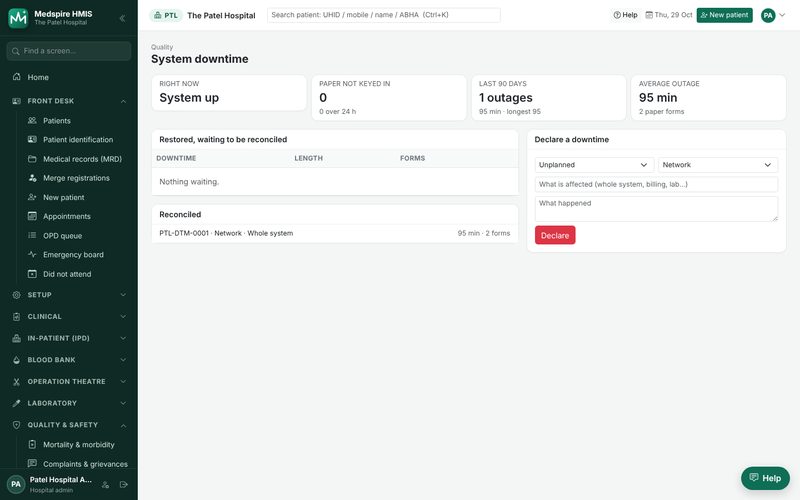
System downtime
When the system is down, work continues on paper and then the forms are lost. The screen records the outage, numbers each paper form, and holds the da…
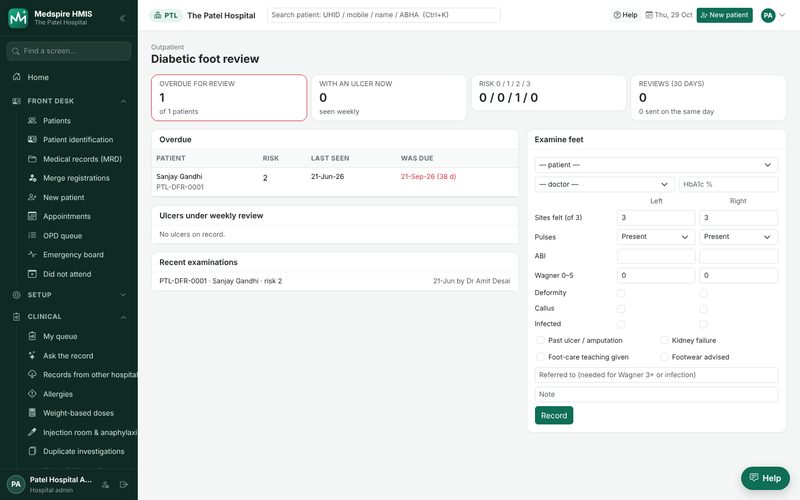
Diabetic foot review
The diabetic foot nobody looked at for two years. Each review records sensation at three sites, pulses, deformity, callus and any ulcer, gives the pat…
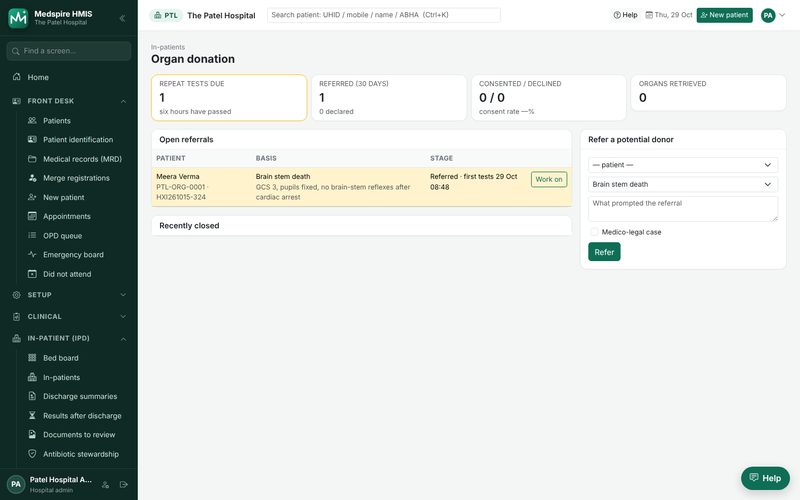
Organ donation
The request for organ donation should not come from the doctor treating the patient, and not before death is declared. The screen follows a deceased-d…
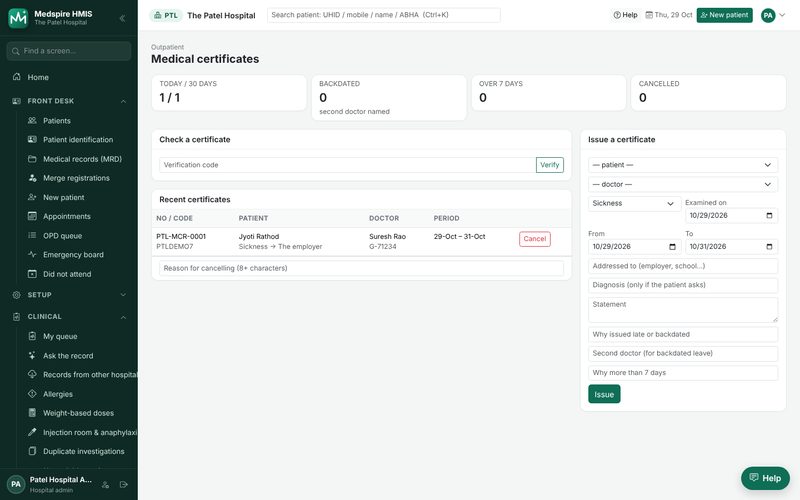
Medical certificates
The sickness certificate written for a friend, with last week's date. A certificate can only be issued by a doctor with a registration number, for a p…
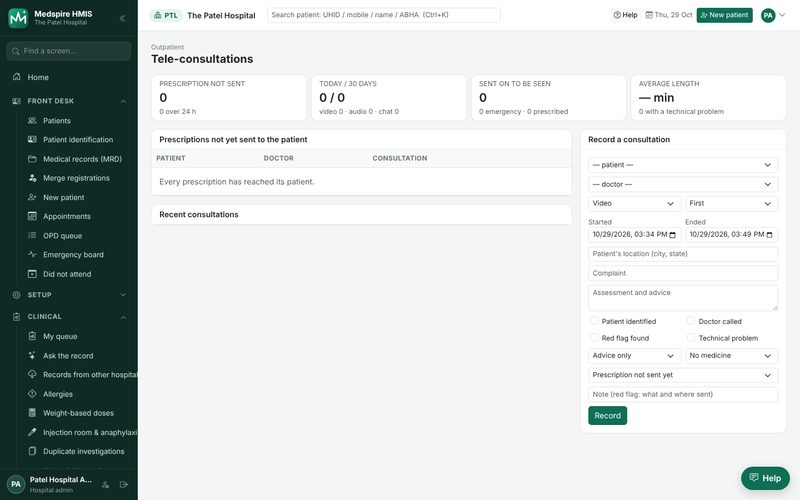
Tele-consultations
A prescription over the phone is only safe if the rules were followed. The screen records the doctor's registration number, who the patient is and whe…
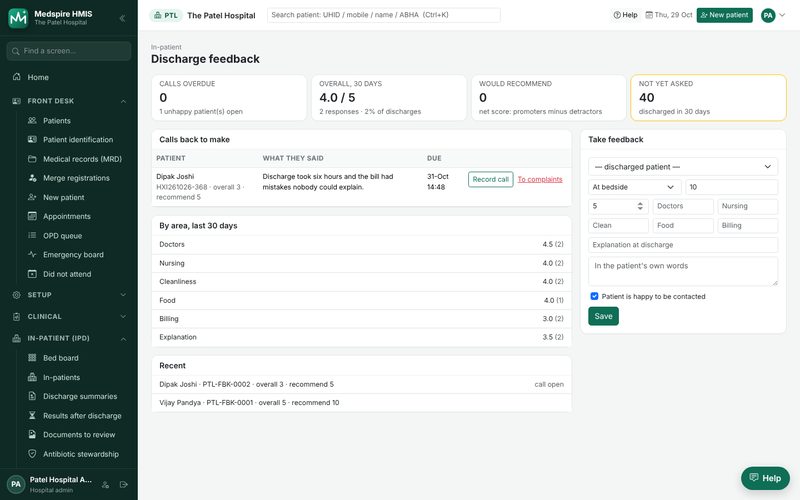
Discharge feedback
The unhappy patient is the one nobody calls. Every discharge is asked six plain questions; a very low score opens a service-recovery case with a call-…
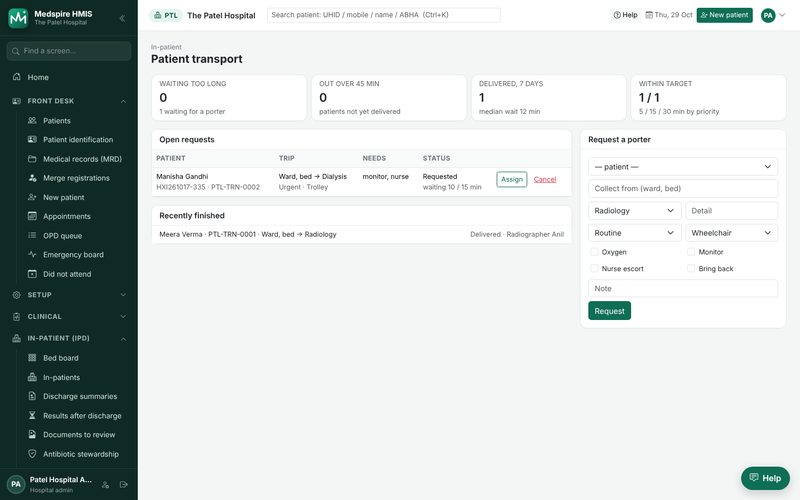
Patient transport
A patient leaves for the scanner and no one knows where they are. Porter requests carry a priority and a mode, bring a nurse escort when oxygen or a m…
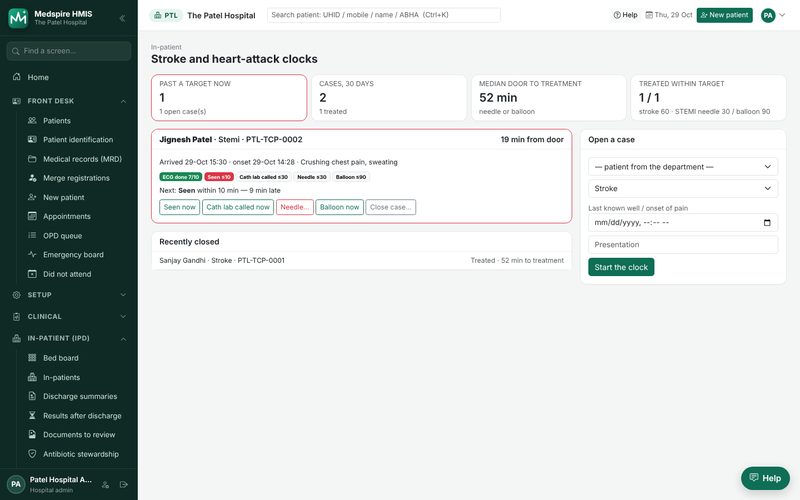
Stroke and heart-attack clocks
For a stroke or a heart attack every minute from the door counts, and nobody can say afterwards how long the patient waited. The clock starts at arriv…
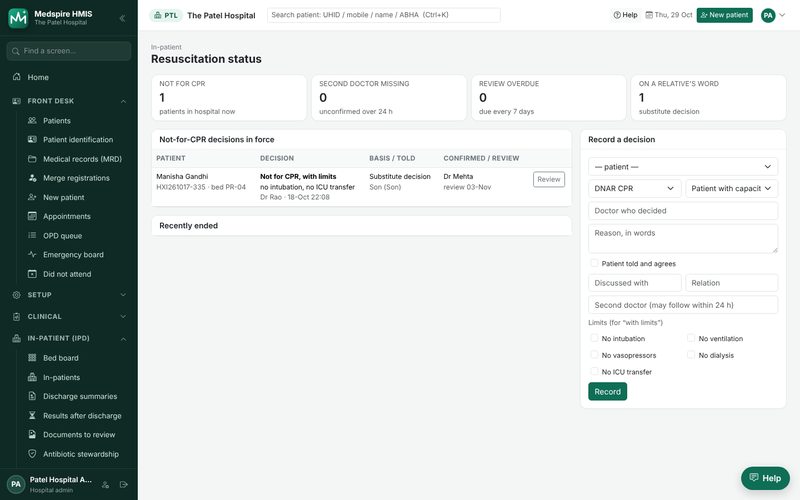
Resuscitation status
"Is this patient for CPR?" is too often answered from memory at three in the morning. The screen holds one current decision per patient: full resuscit…
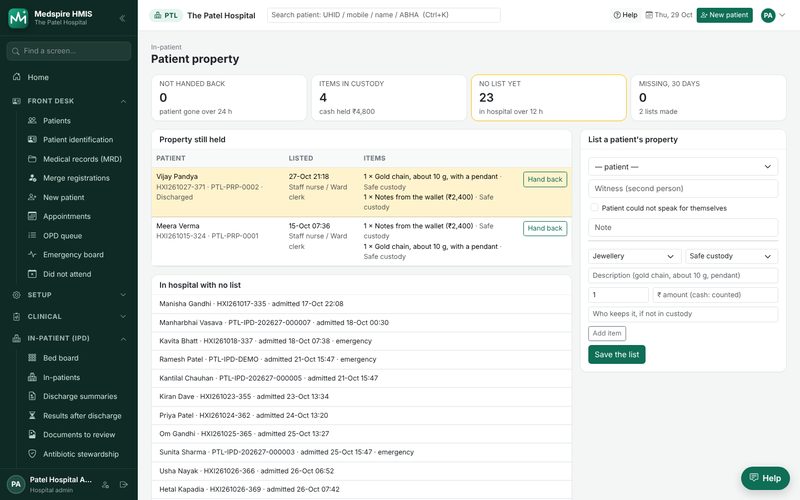
Patient property
The first complaint after a death or a night admission is often about a chain. A list made with a witness and signed back is the only answer.
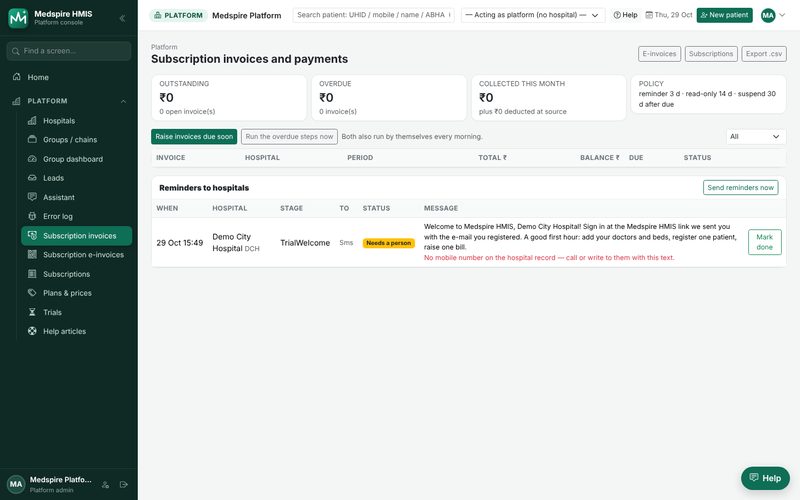
Reminders by e-mail
An accounts department reads e-mail; an SMS to the owner's mobile does not reach it.
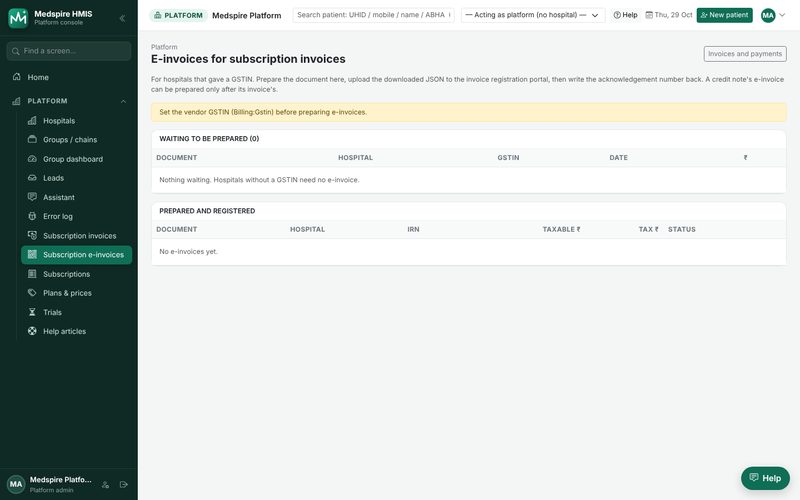
Support access, e-invoices, online payment
Staff who can see a hospital's data should leave a trace; money should be collectable without a bank-statement chase; GST-registered customers need IR…
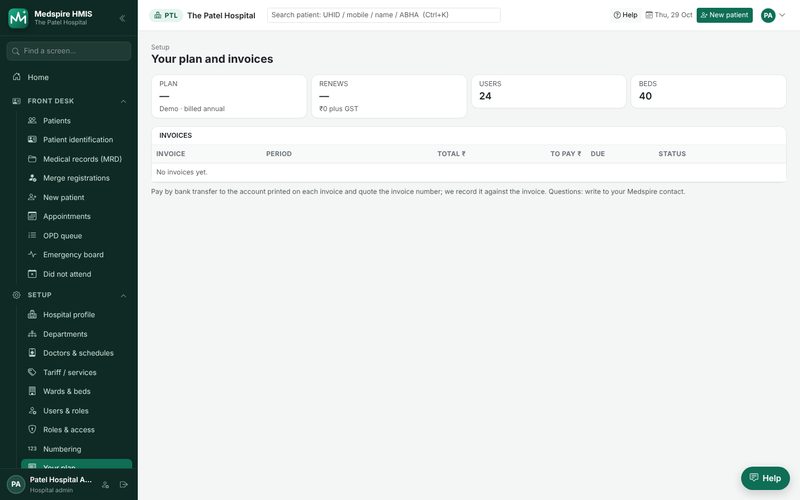
Instalments, credit notes and trial tracking
Hospitals pay in parts and bargain afterwards; a ledger that can only say paid or unpaid forces notes into e-mail. A trial that nobody follows up is a…
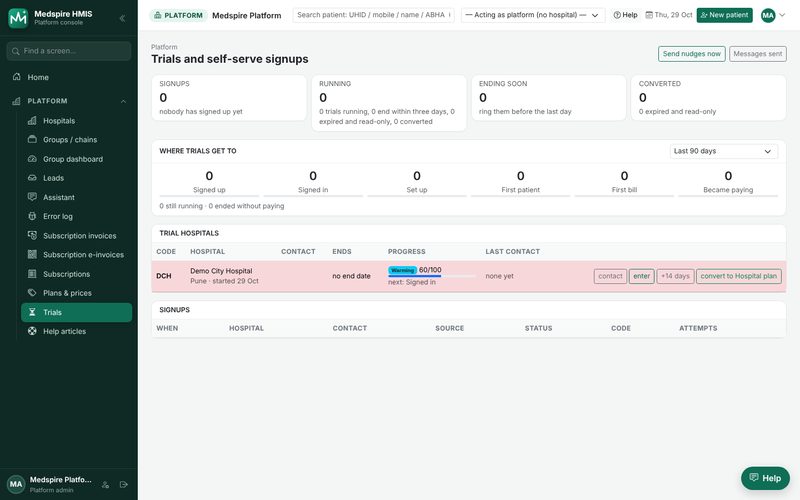
Billing reminders
Read-only and suspension should never be a surprise. Each stage is announced once, in order, to the person the hospital gave as its contact, and what…
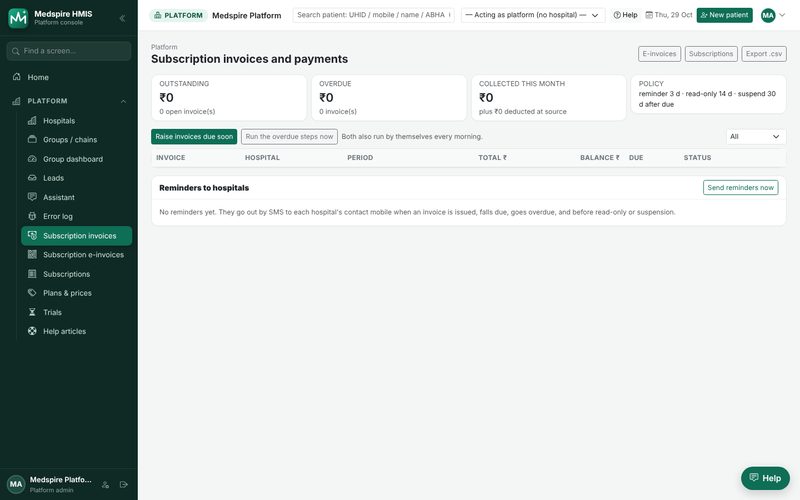
Invoices, payments and the overdue ladder
A renewal date nobody invoices is a date that passes. The invoice goes out before the renewal, the payment is matched to a bank reference, and what ha…
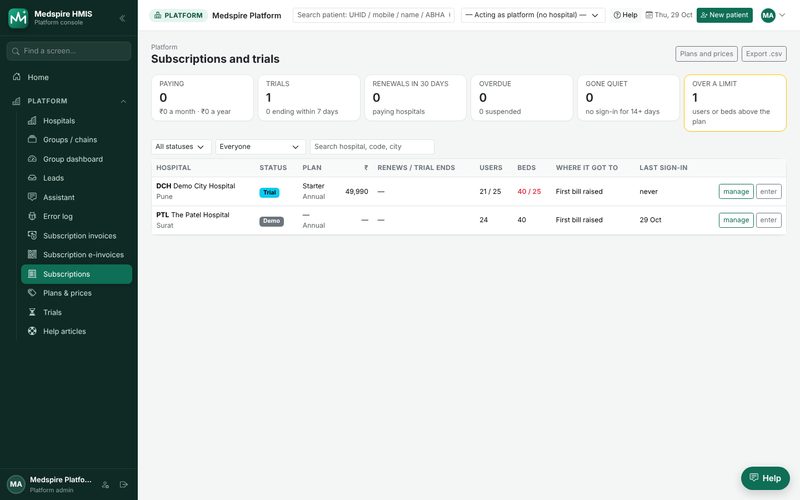
Subscriptions
The platform could say a hospital was on "Starter" but not what it paid, when it renews, whether it uses what it bought, or who agreed a discount. Mon…
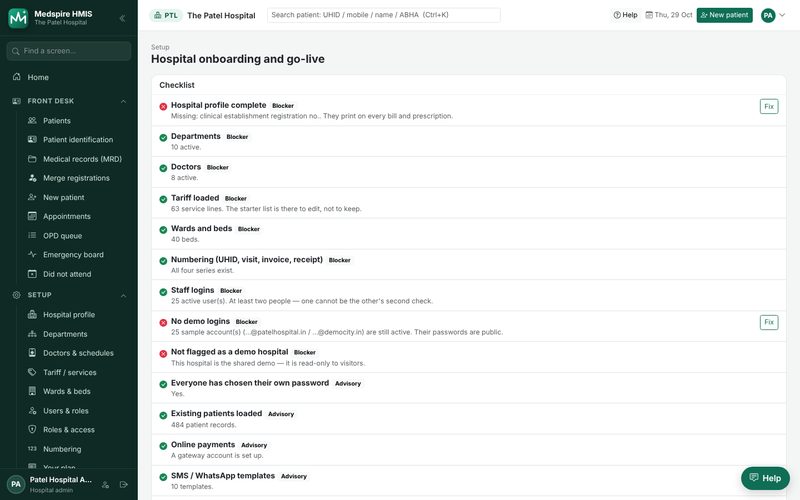
Opening day
The first week of a new hospital is lost to things nobody owned: sample logins left active, a starter tariff, an old register in a spreadsheet. A list…
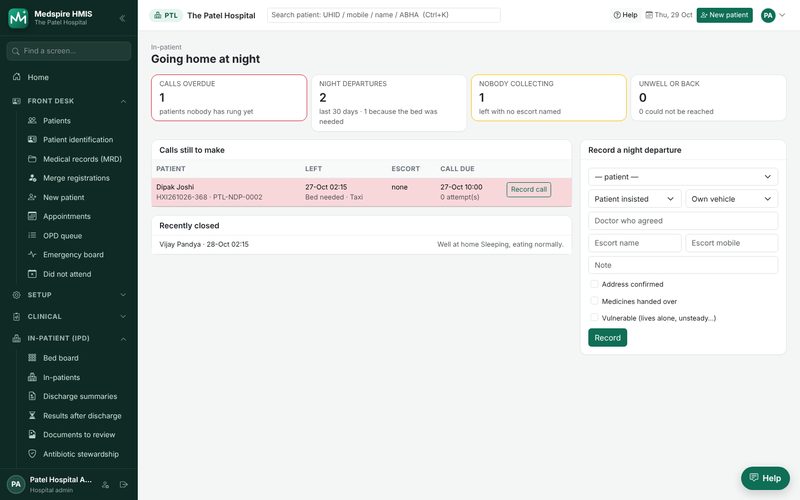
Going home at night
A discharge at two in the morning is sometimes the patient's wish and sometimes the hospital's need for the bed. Either way someone should know who ca…
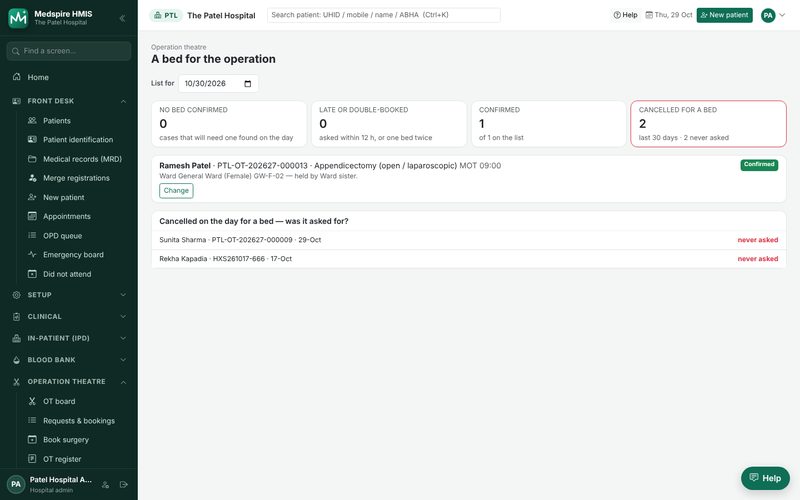
A bed for the operation
The list is built a day ahead and the bed is found on the day, by phone, with the patient already fasting and the surgeon scrubbed. The cancellation r…
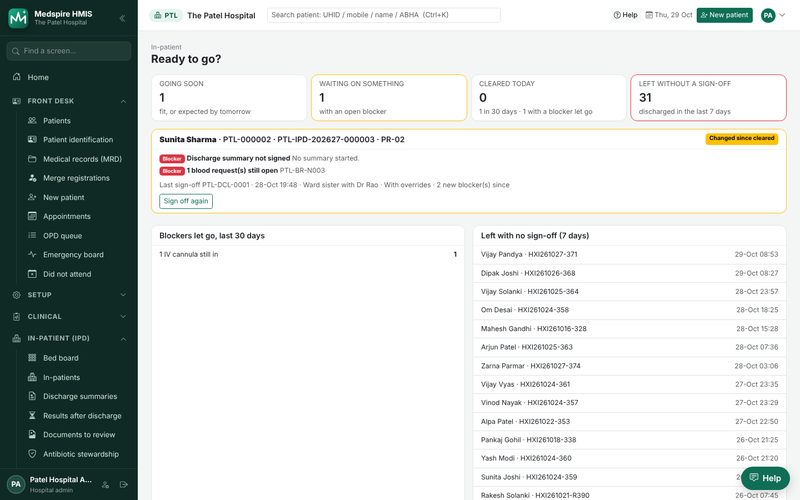
Ready to go?
The lab knows a culture is pending, radiology that a scan is unreported, the ward that a cannula is still in, billing that ₹8,400 is unpaid, the pharm…
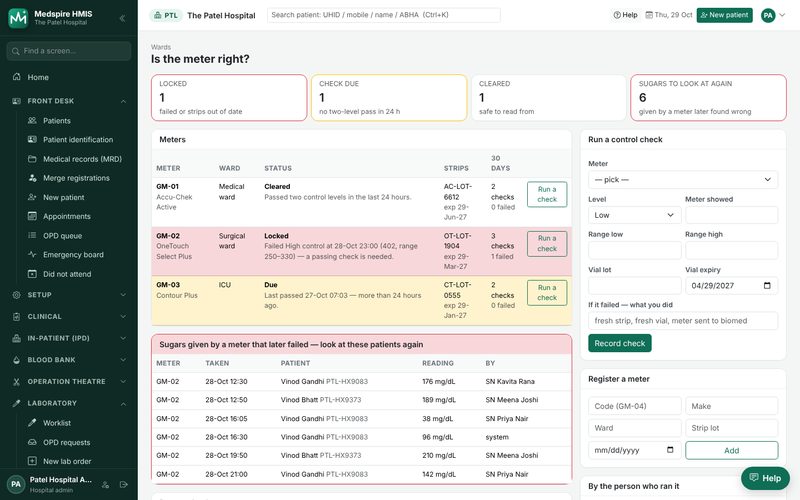
Is the meter right?
A nurse reads 38 and treats, or 220 and doses, and nobody asks whether that meter was ever checked. A meter outside its control range gives confident…
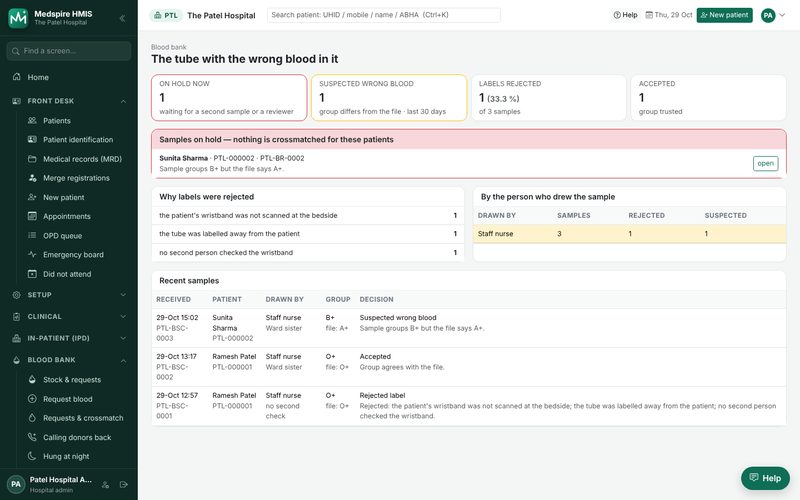
The tube with the wrong blood in it
A group that differs from the file is the one moment a wrong-blood-in-tube can still be caught, and the old code spent it by overwriting the file. A p…
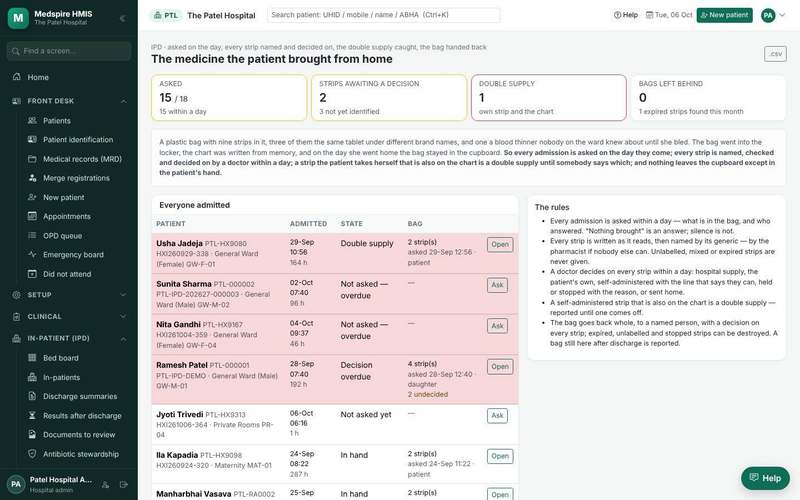
The medicine the patient brought from home
A plastic bag with nine strips in it, three of them the same tablet under different brand names, and one a blood thinner nobody on the ward knew she w…
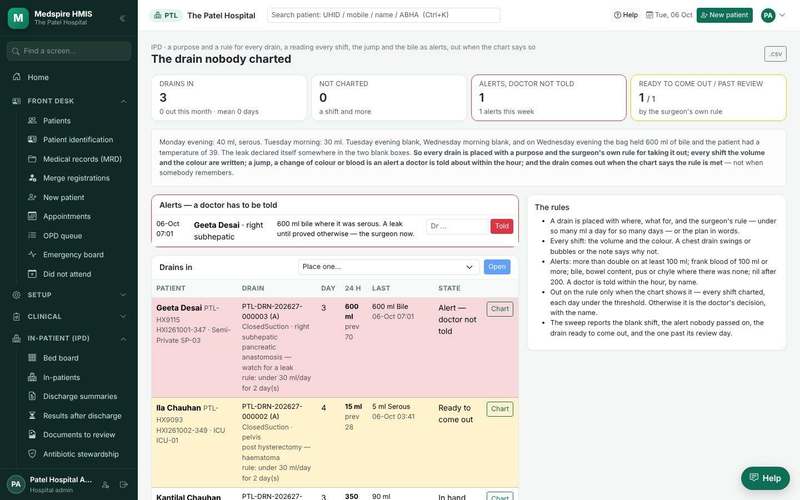
The drain nobody charted
The chart had Monday evening: 40 ml, serous. Tuesday morning: 30 ml. Tuesday evening blank, Wednesday morning blank, and on Wednesday evening the bag…
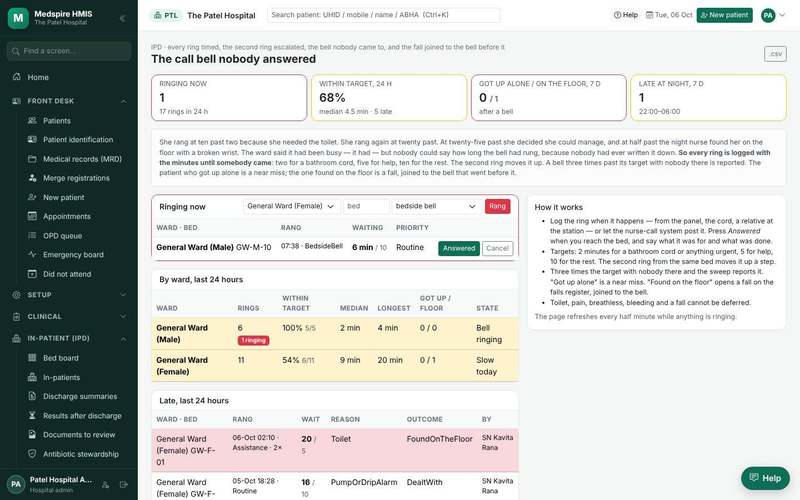
The call bell nobody answered
She rang at ten past two because she needed the toilet. She rang again at twenty past. At twenty-five past she decided she could manage, and at half p…
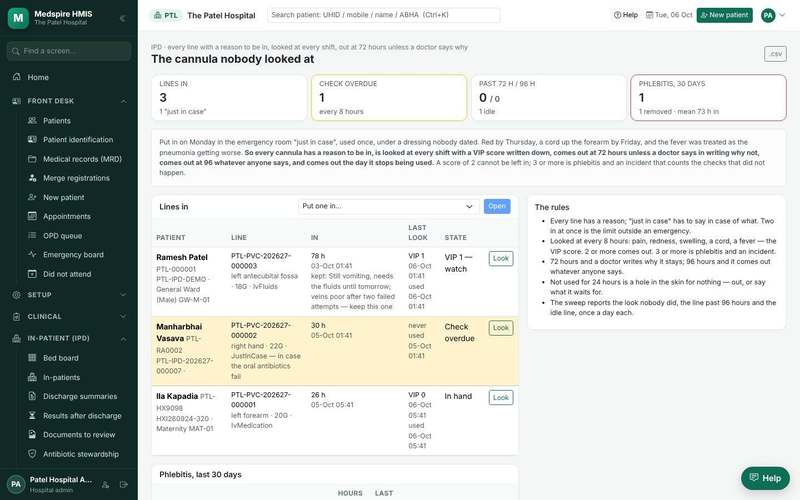
The cannula nobody looked at
Put in on Monday in the emergency room 'just in case', used once for a dose of paracetamol, under a dressing nobody dated. Red by Thursday, a cord up…
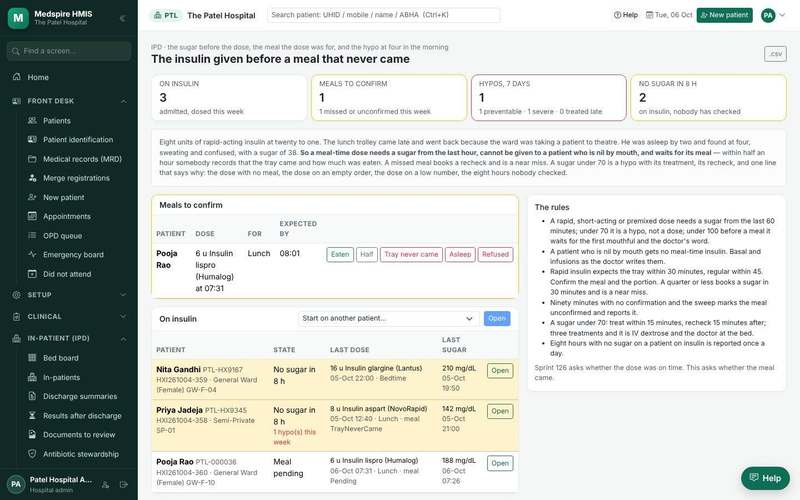
The insulin given before a meal that never came
Eight units of rapid-acting insulin at twenty to one. The lunch trolley came late and went back because the ward was taking a patient to theatre; he w…
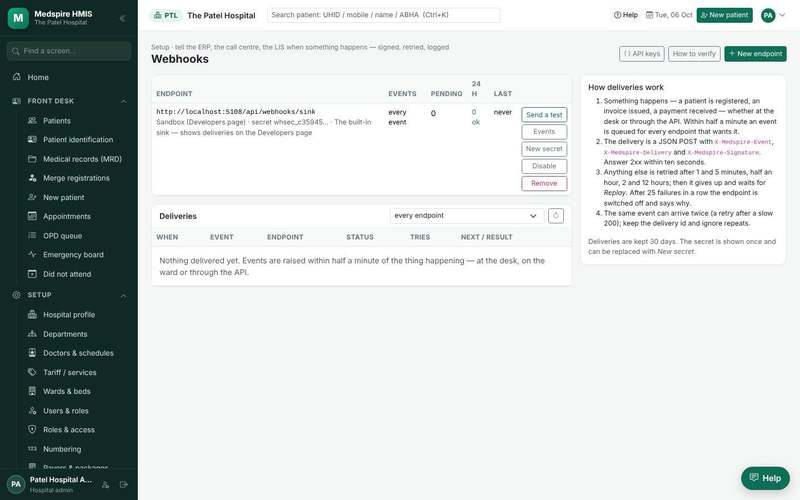
Webhooks, OAuth2 and the first ERP load
Sprint 164 let systems ask; this lets the hospital tell them, lets a platform that only speaks OAuth2 in, and gives the ERP its opening balance.
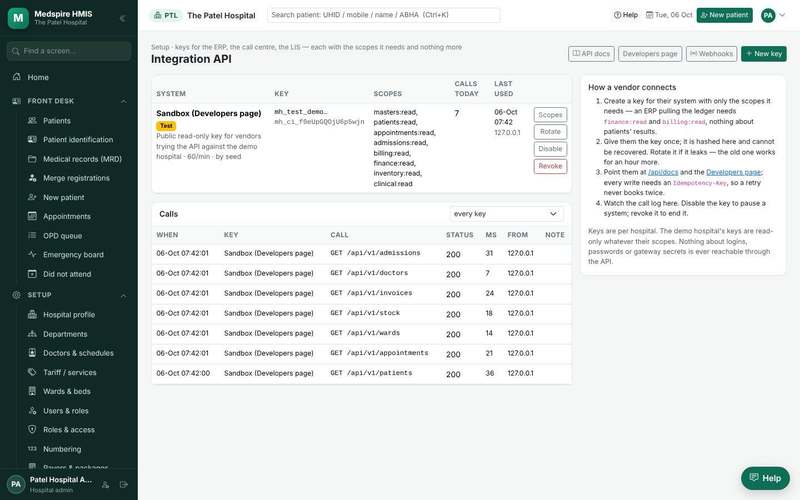
The integration API
An ERP (Tally, SAP, Zoho), a call centre, a kiosk, a LIS/PACS vendor or a referral network had no way in except a person re-typing. Every /api/… route…
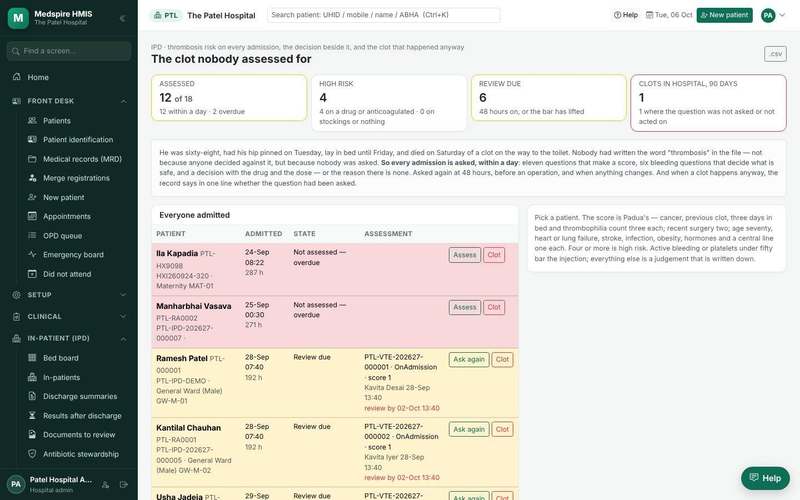
The clot nobody assessed for
He was sixty-eight, had his hip pinned on Tuesday, lay in bed until Friday, and died on Saturday of a pulmonary embolus on the way to the toilet. The…
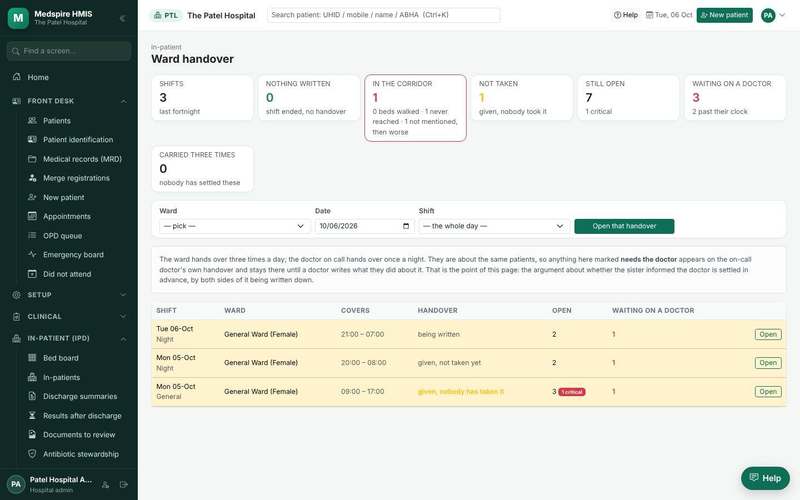
The handover that happened in the corridor
The evening nurse handed over in the corridor, standing, to a night nurse who had just arrived and had her bag on her shoulder, and said "bed 5 is the…
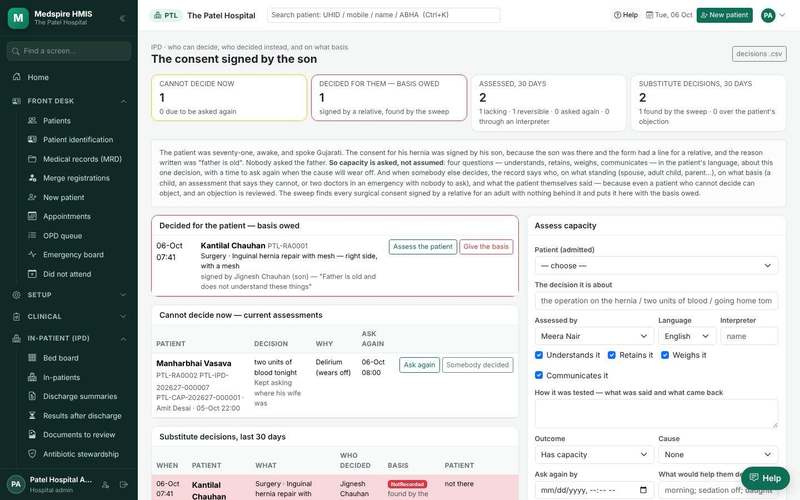
The consent signed by the son
The patient was seventy-one, awake, and spoke Gujarati; the consent for his hernia was signed by his son because the son was there, the form had a lin…
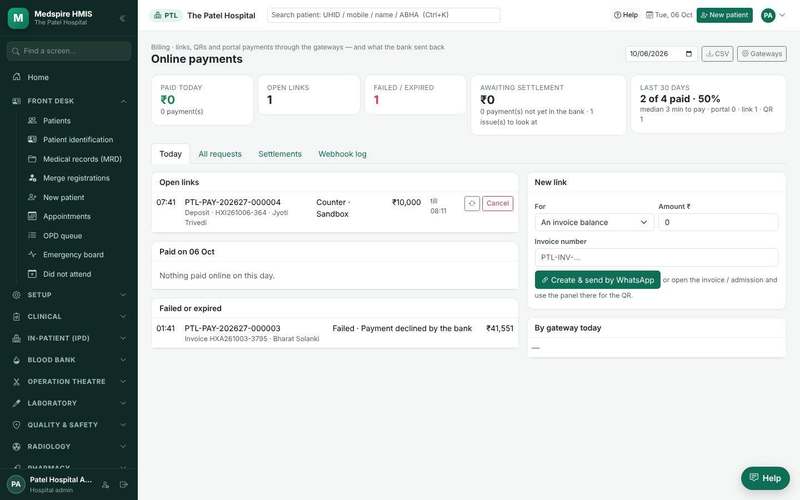
The settlement that did not add up
The bank credit was ₹34,859.43 and nobody could say why. The gateway's dashboard said ₹35,702 collected; the difference was the fee and its GST, which…
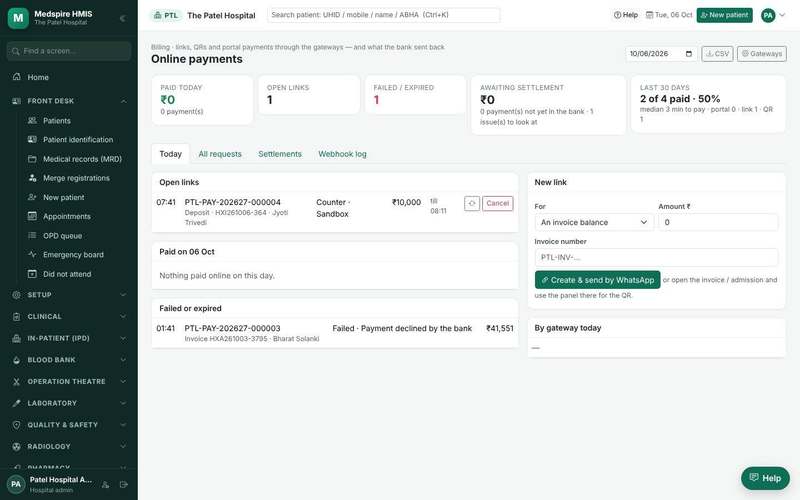
The payment that came by link
The bill was ₹7,986 and the son had left his wallet at home. He had the money on his phone; the counter had a card machine that took four minutes and…
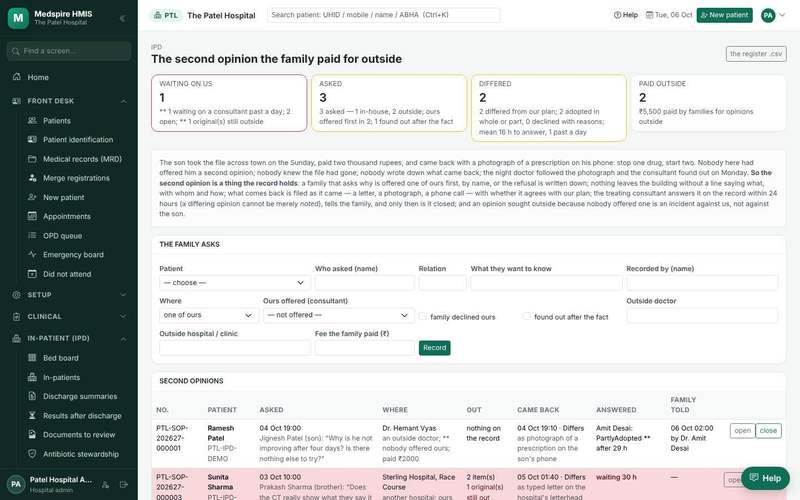
The second opinion the family paid for outside
The photograph on the phone was followed because nobody had written down that it existed, let alone what the consultant thought of it. Recording the r…
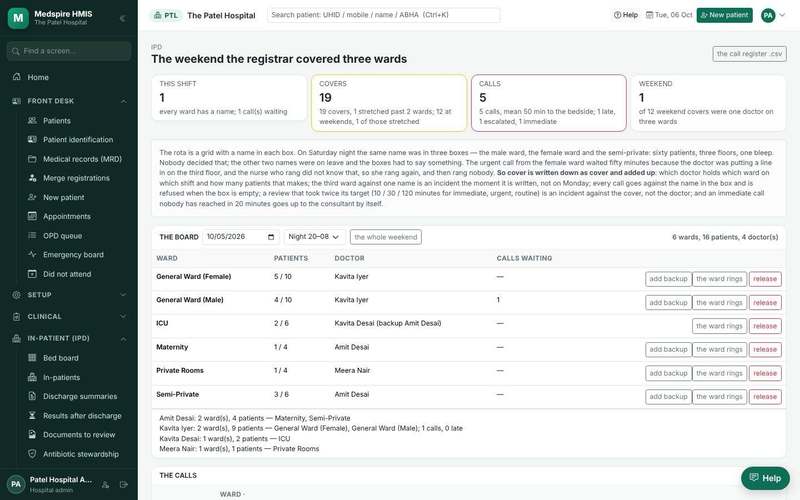
The weekend the registrar covered three wards
The rota had a name in every box and nobody added the boxes up. Writing cover as cover makes the arithmetic visible when it is written, not at the M&M…
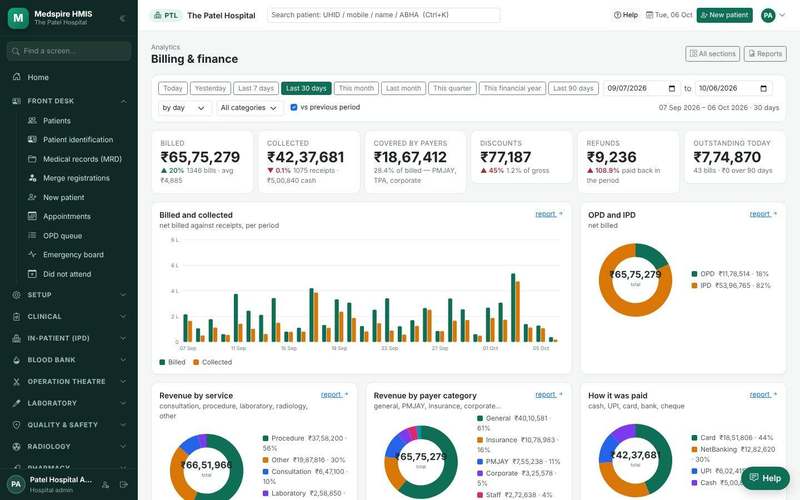
Analytics: billing & finance, claims, workforce, quality, group
The first three sprints answered what happened in the department; this one answers what did it cost, what did we get paid, who was there, and what wen…
Analytics: laboratory, radiology, pharmacy, blood bank, stores & assets
These are the departments whose failures are quiet: a result that took a day longer than it should, a batch that expired on the shelf, a unit of blood…
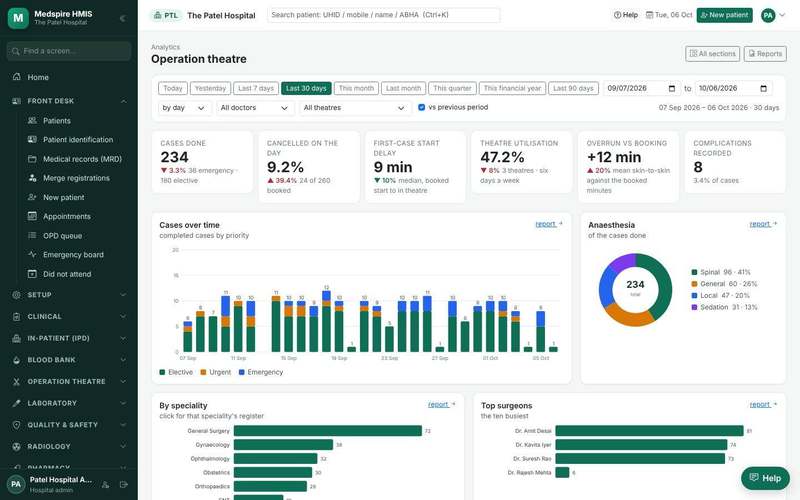
Analytics: operation theatre and emergency
A theatre that is 50% used with a quarter of first cases starting late is a theatre paying for a list it is not running; a department that sees urgent…
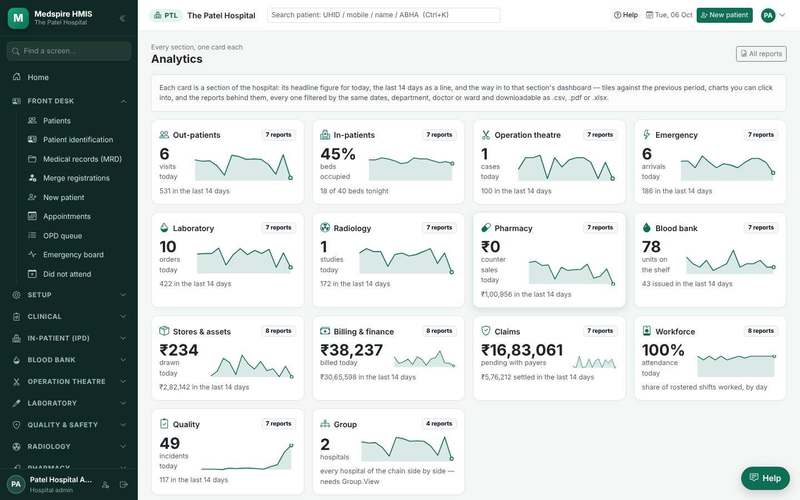
Analytics dashboards & reports: the foundation
The home dashboard was tiles for one day and the reports were scattered — an OPD register here, a cashbook there, each with its own date boxes and its…
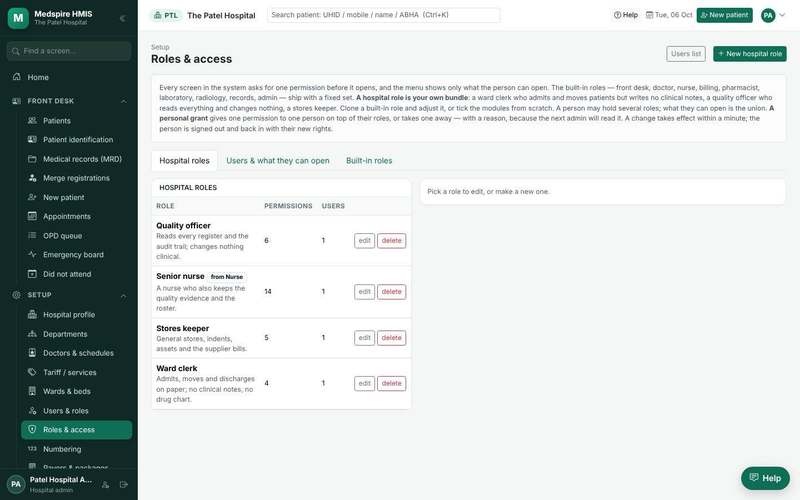
Roles & access
Every screen asks for one permission and the menu shows only what the person can open — that has been true since Sprint 1 — but the roles were fixed a…
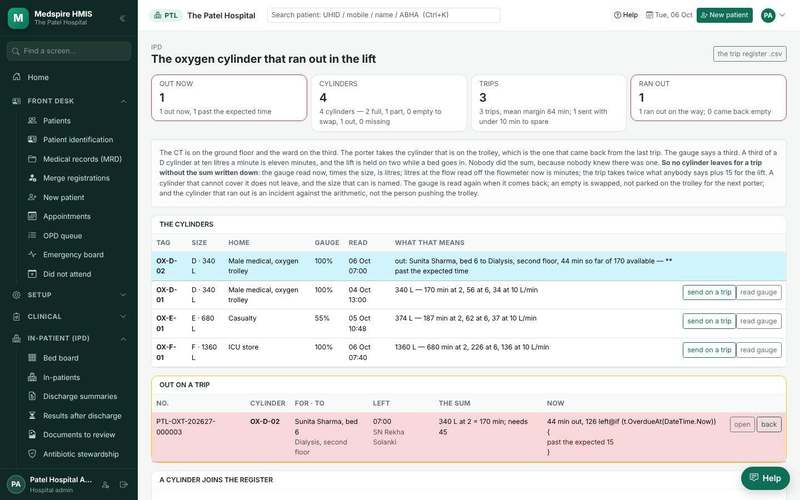
The oxygen cylinder that ran out in the lift
The CT is on the ground floor and the ward on the third; the porter takes the cylinder on the trolley, which is the one that came back last. The gauge…
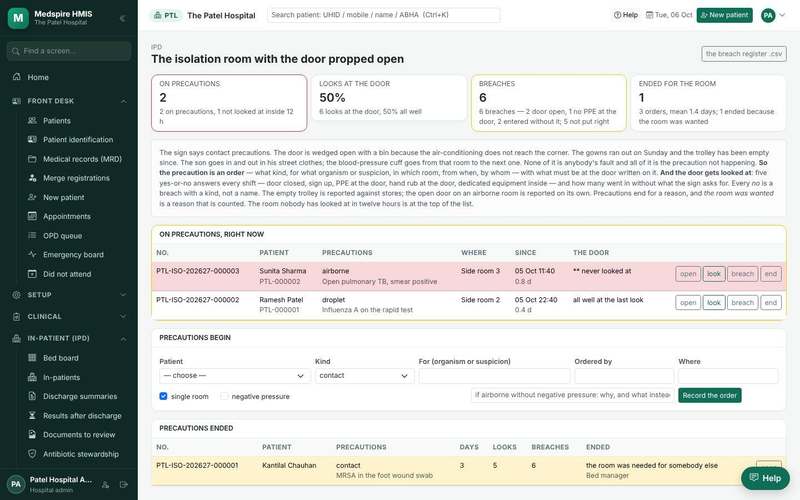
The isolation room with the door propped open
The sign says contact precautions; the door is wedged with a bin for the air; the gowns ran out on Sunday; the son goes in and out in his street cloth…
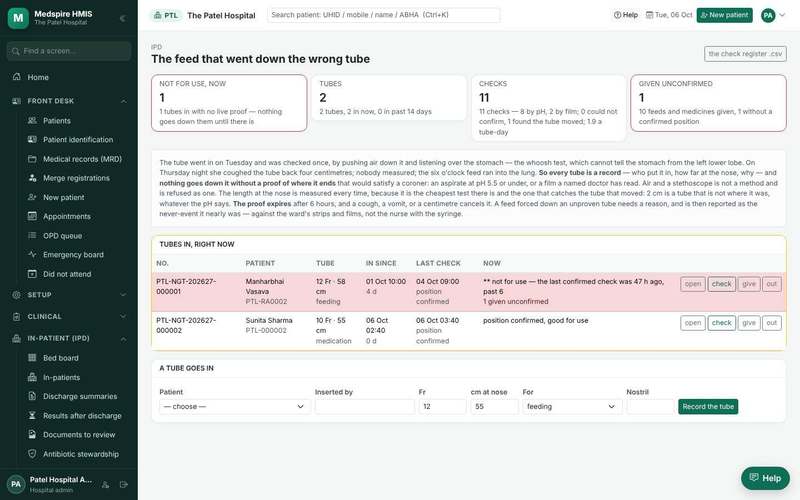
The feed that went down the wrong tube
The tube went in on Tuesday and was checked once by pushing air down it and listening over the stomach, which cannot tell the stomach from the left lo…
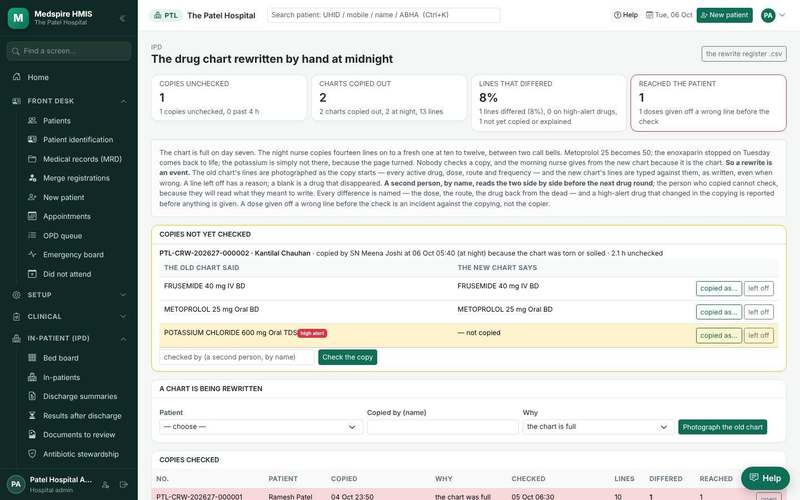
The drug chart rewritten by hand at midnight
The chart is full on day seven; the night nurse copies fourteen lines on to a fresh one at ten to twelve between two call bells. Metoprolol 25 becomes…
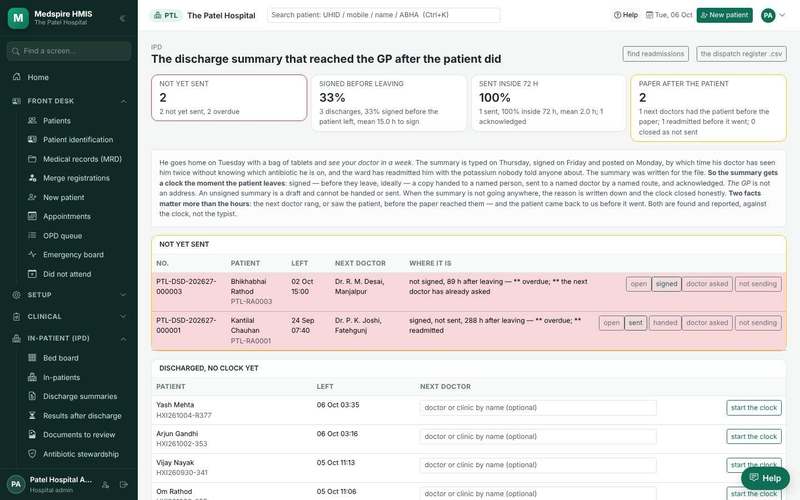
The discharge summary that reached the GP after the patient did
He goes home on Tuesday with a bag of tablets and see your doctor in a week. The summary is typed on Thursday, signed on Friday and posted on Monday;…
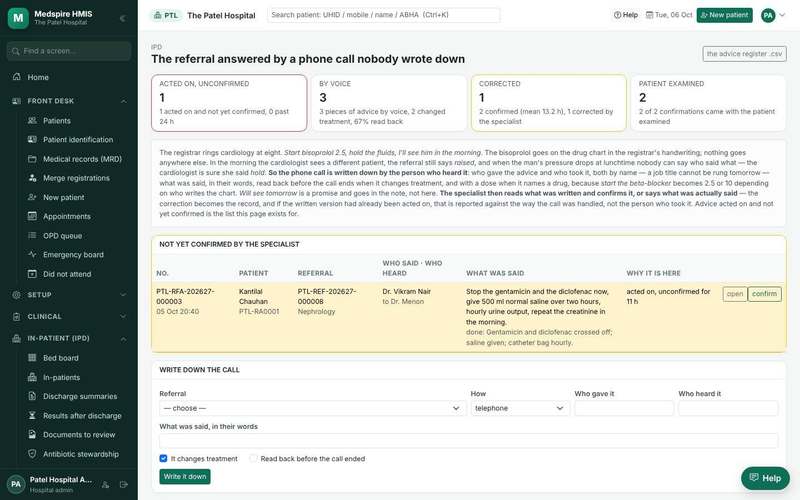
The referral answered by a phone call nobody wrote down
The registrar rings cardiology at eight and is told start bisoprolol 2.5, hold the fluids, I'll see him in the morning. The bisoprolol goes on the cha…
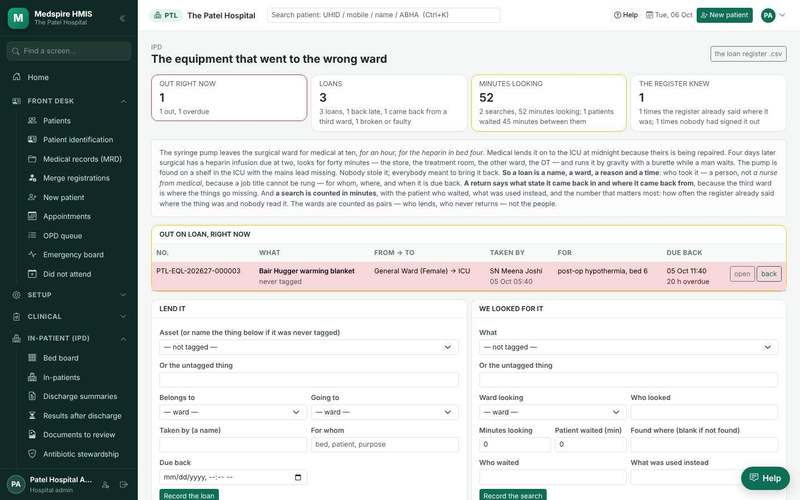
The equipment that went to the wrong ward
The syringe pump leaves surgical for medical at ten for an hour, for the heparin in bed four; medical lends it on to the ICU at midnight; four days la…
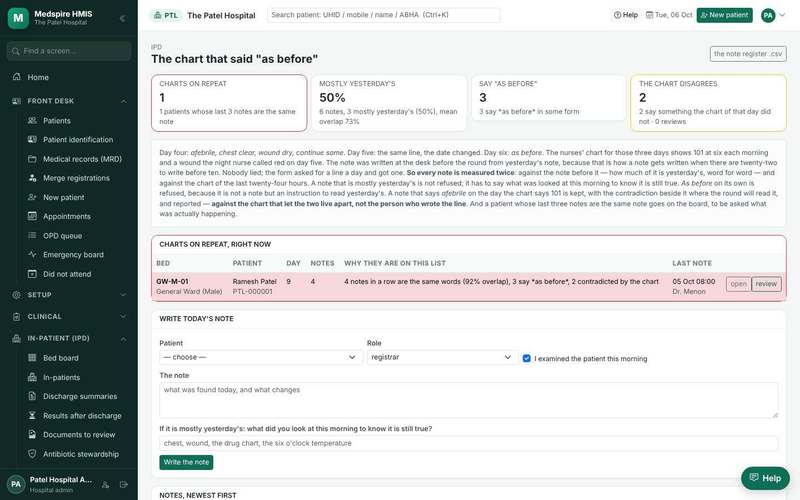
The chart that said "as before"
Day four: afebrile, chest clear, wound dry, continue same. Day five: the same line with the date changed. Day six: as before. The nurses' chart shows…
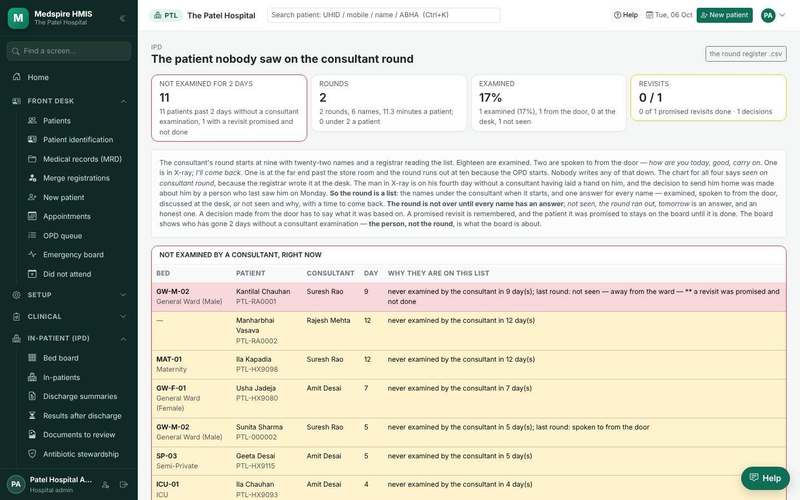
The patient nobody saw on the consultant round
Twenty-two names, eighteen examined, two spoken to from the door, one in X-ray with I'll come back, one at the far end when the round ran out at ten.…
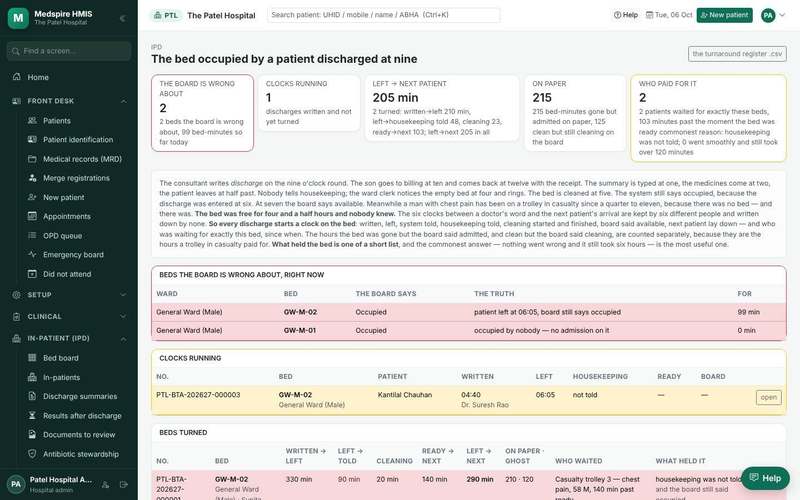
The bed occupied by a patient discharged at nine
The consultant writes discharge at nine. Billing till twelve, the summary at one, the medicines at two, the patient leaves at half past. Nobody tells…
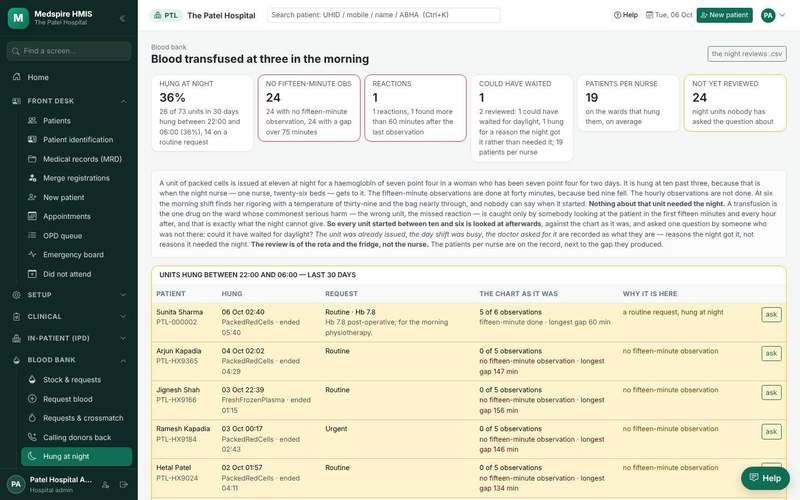
Blood transfused at three in the morning
A unit issued at eleven for a haemoglobin that had been 7.4 for two days is hung at ten past three by one nurse with twenty-six beds. The fifteen-minu…
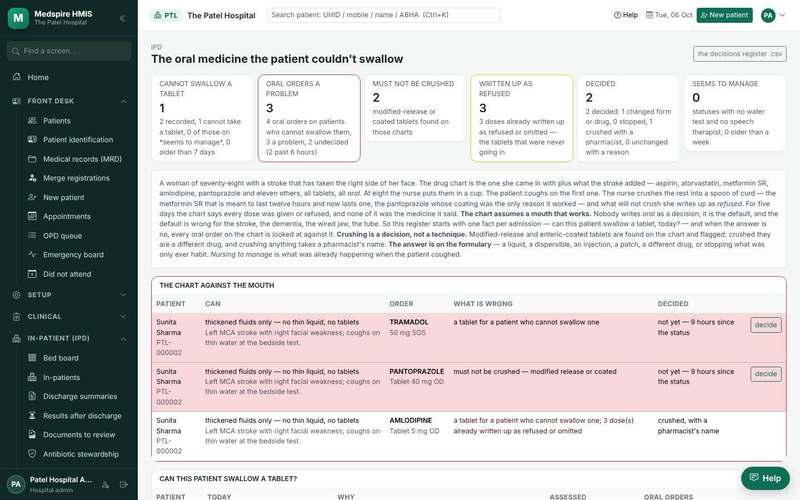
The oral medicine the patient couldn't swallow
A woman of seventy-eight with a stroke has sixteen tablets on the chart, all oral. At eight the nurse puts them in a cup; the patient coughs on the fi…
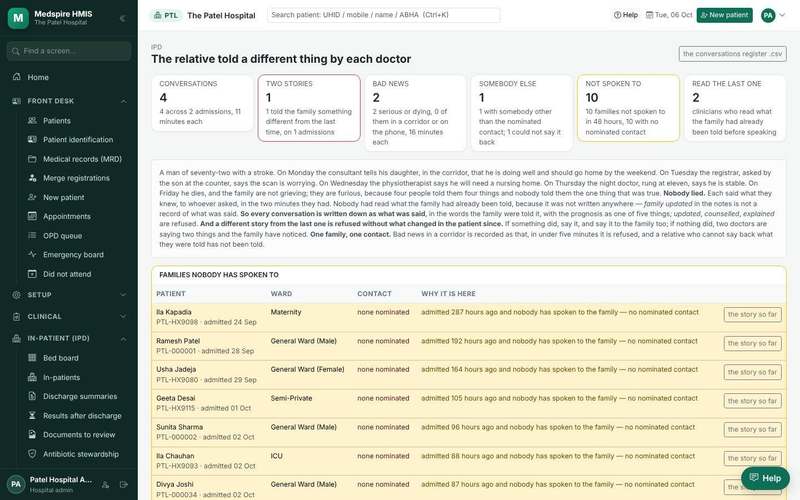
The relative told a different thing by each doctor
A man of seventy-two with a stroke is told to his daughter on Monday, in the corridor, as home by the weekend; to his son on Tuesday, at the counter,…
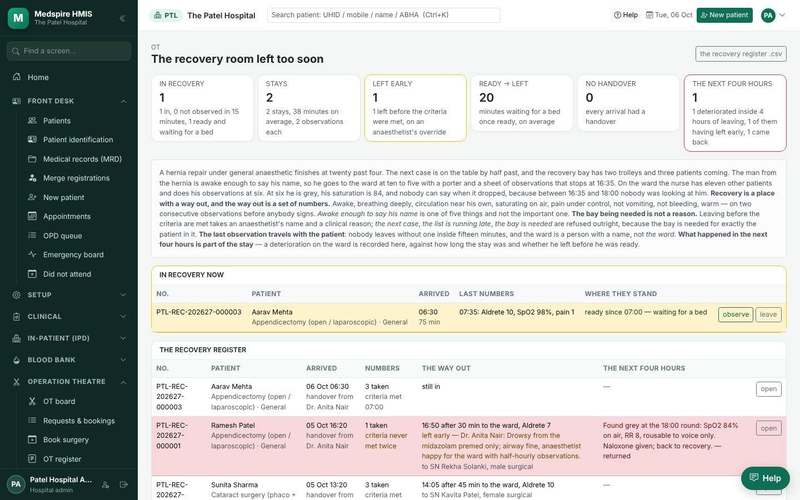
The recovery room left too soon
A hernia repair under general anaesthetic finishes at twenty past four; the next case is on the table by half past and the bay has two trolleys and th…
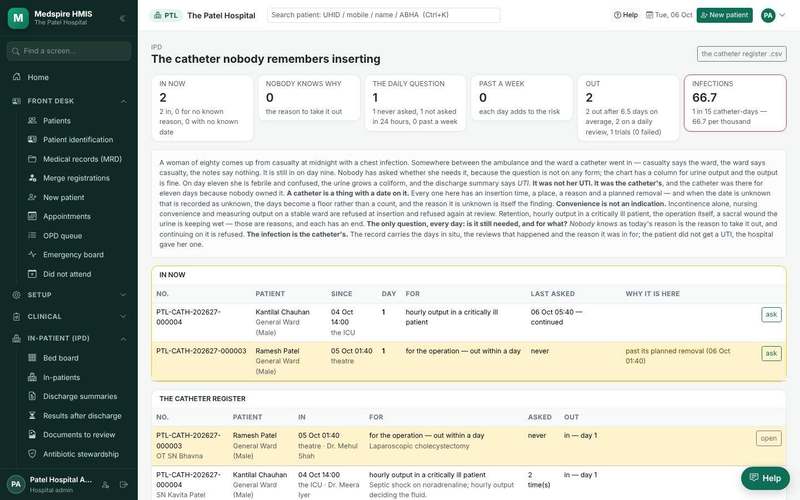
The catheter nobody remembers inserting
A woman of eighty comes up from casualty at midnight; somewhere between the ambulance and the ward a catheter went in, and casualty says the ward, the…
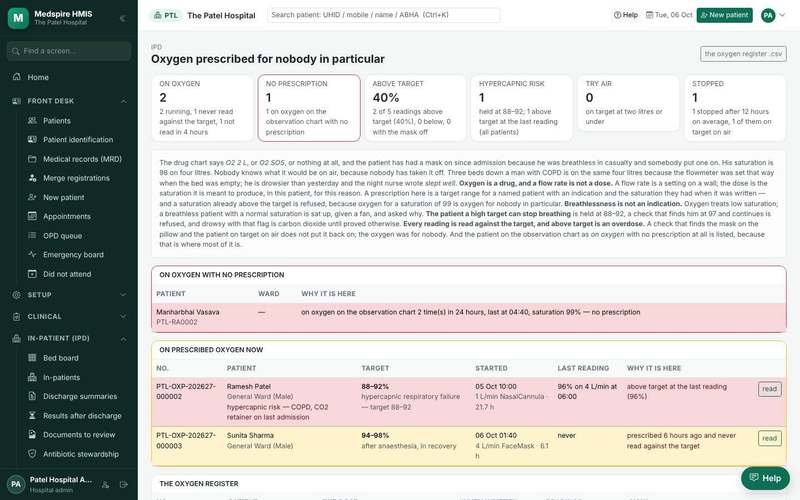
Oxygen prescribed for nobody in particular
The drug chart says O2 2 L or O2 SOS or nothing, and the patient has had a mask on since casualty because he was breathless and somebody put one on. H…
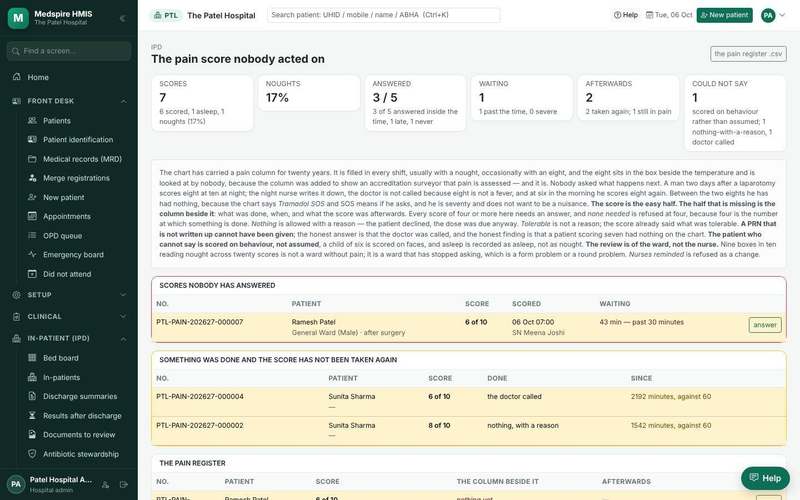
The pain score nobody acted on
The chart has carried a pain column for twenty years, filled in every shift, usually with a nought and occasionally with an eight, and the eight sits…
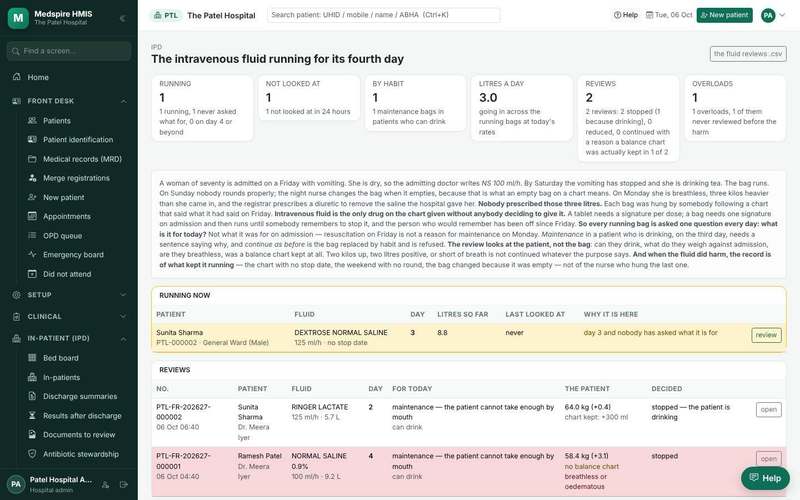
The intravenous fluid running for its fourth day
A woman of seventy is admitted on a Friday with vomiting; the doctor writes NS 100 ml/h. By Saturday she is drinking tea. The bag runs. On Sunday nobo…
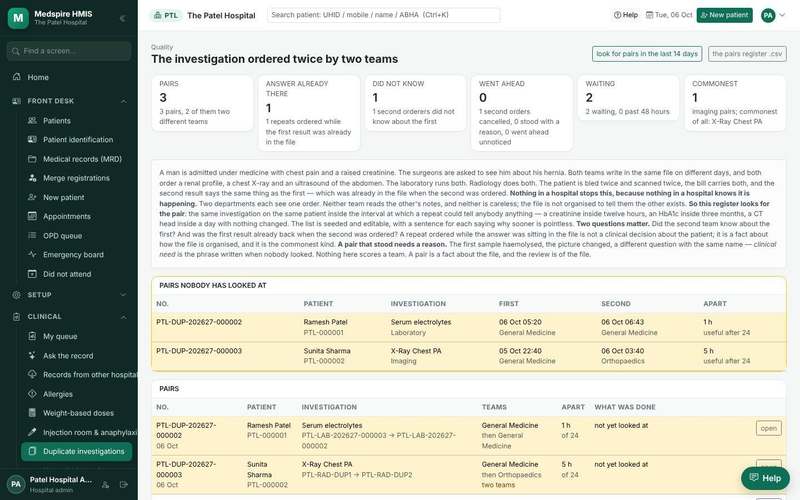
The investigation ordered twice by two teams
A man admitted under medicine is seen by the surgeons about his hernia. Both teams write in the same file on different days and both order a renal pro…
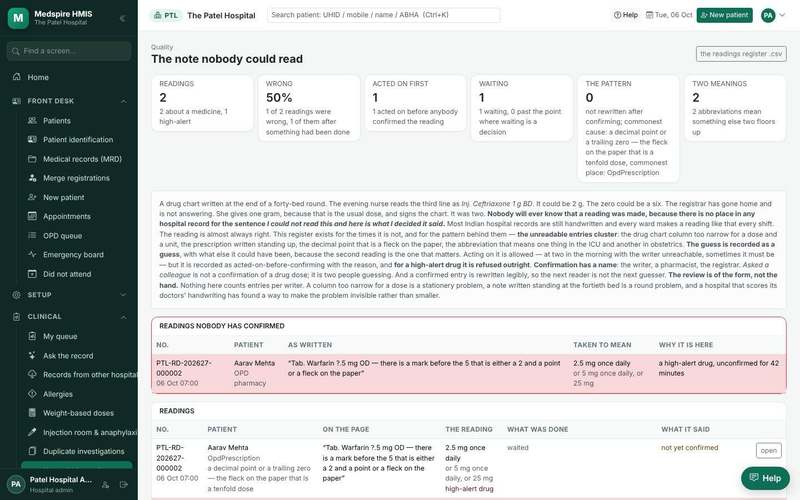
The note nobody could read
A drug chart written at the end of a forty-bed round. The evening nurse reads the third line as Inj. Ceftriaxone 1 g BD. It could be 2 g; the registra…
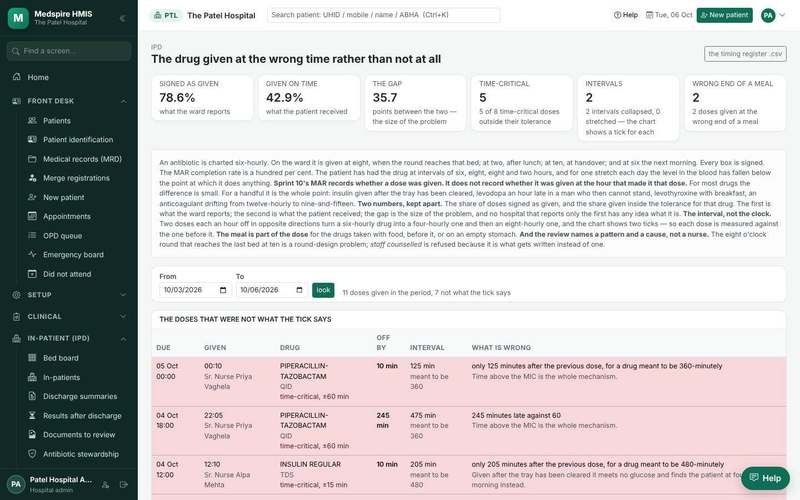
The drug given at the wrong time rather than not at all
An antibiotic is charted six-hourly. On the ward it is given at eight when the round reaches that bed, at two after lunch, at ten at handover, and at…
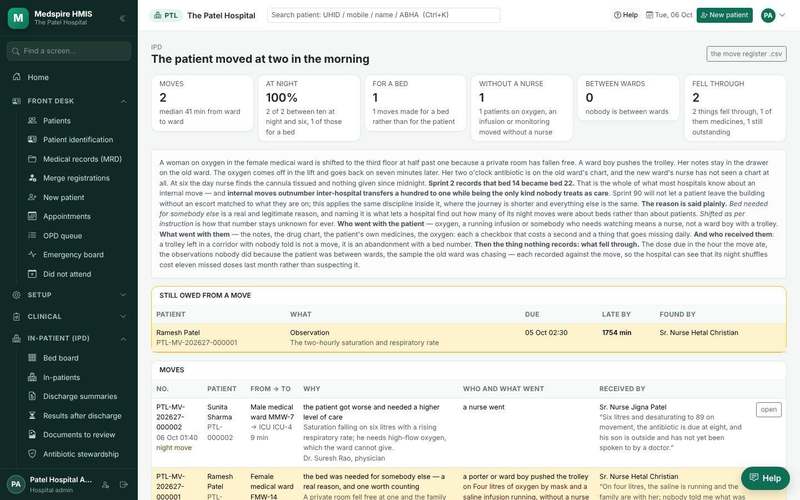
The patient moved at two in the morning
A woman on oxygen is shifted to the third floor at half past one because a private room has fallen free. A ward boy pushes the trolley. Her notes stay…
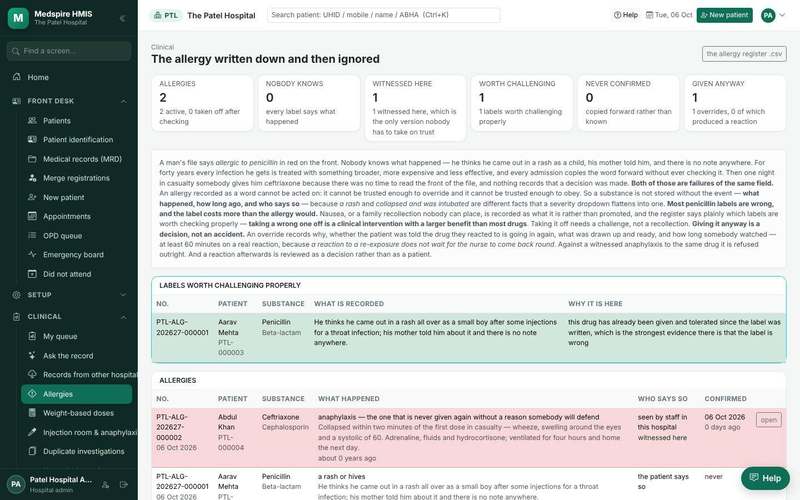
The allergy written down and then ignored
A man's file says allergic to penicillin in red on the front. Nobody knows what happened — he thinks he came out in a rash as a child, his mother told…
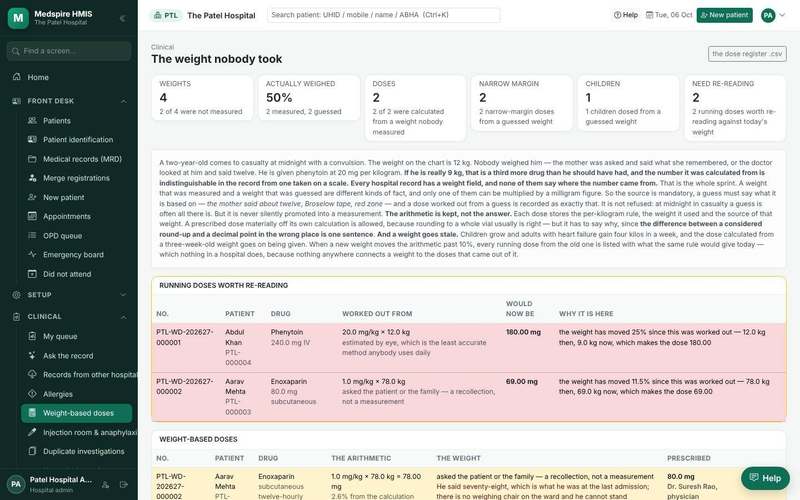
The weight nobody took
A two-year-old comes to casualty at midnight with a convulsion. The weight on the chart is 12 kg. Nobody weighed him — the mother was asked and said w…
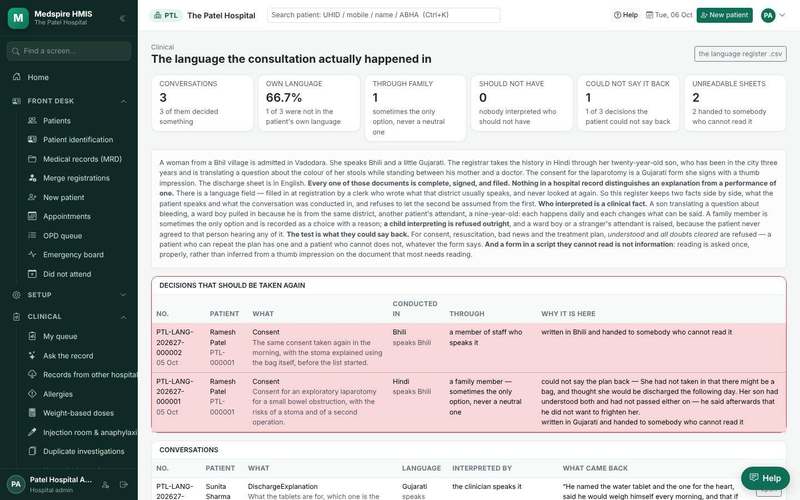
The language the consultation actually happened in
A woman from a Bhil village is admitted in Vadodara. She speaks Bhili and a little Gujarati. The registrar takes the history in Hindi through her twen…
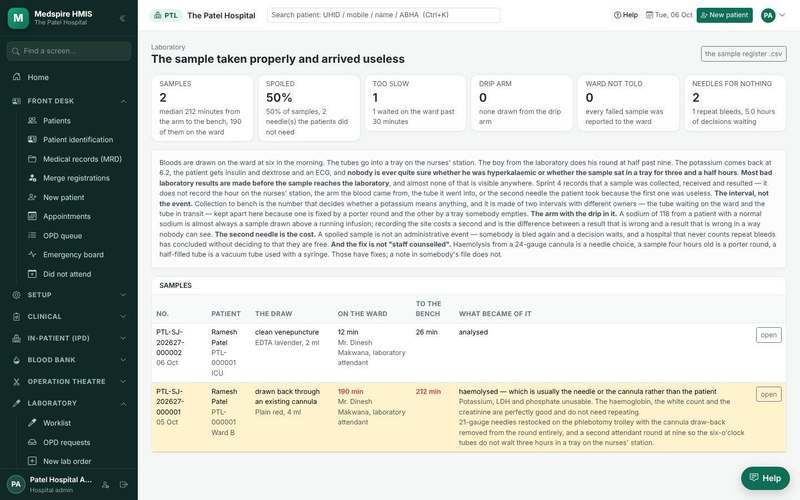
The sample taken properly and arrived useless
Bloods are drawn on the ward at six in the morning. The tubes go into a tray on the nurses' station. The boy from the laboratory does his round at hal…
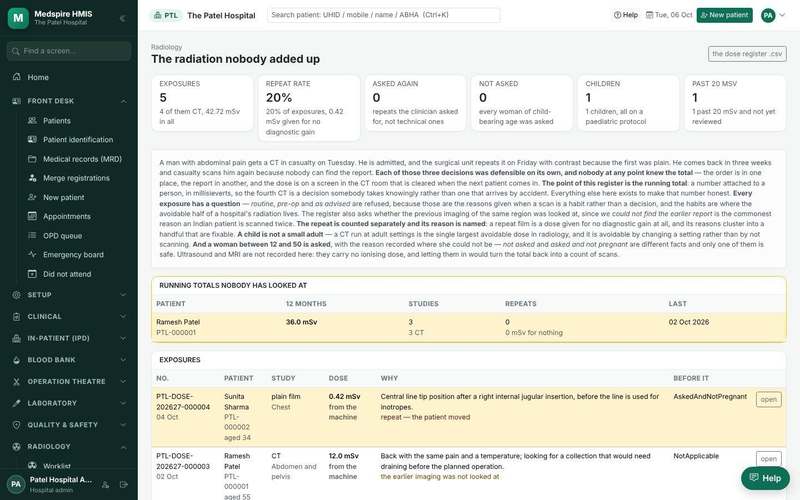
The radiation nobody added up
A man with abdominal pain gets a CT in casualty on Tuesday. He is admitted and the surgical unit repeats it on Friday with contrast because the first…
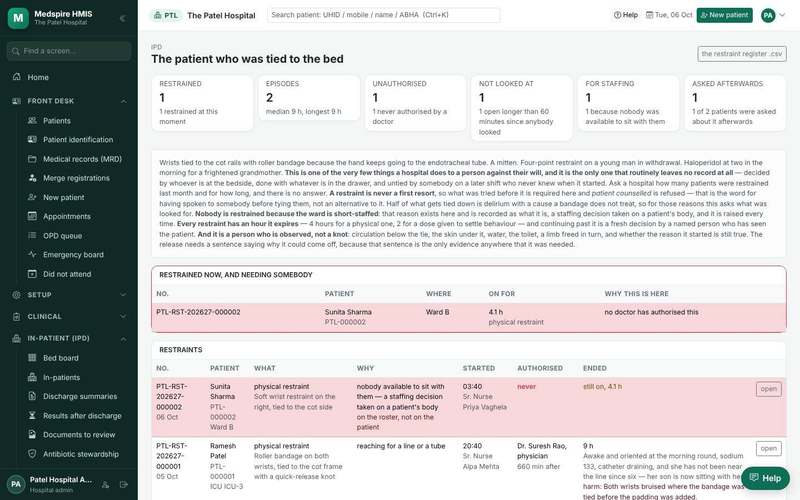
The patient who was tied to the bed
Restraint is one of the very few things a hospital does to a person against their will, and it is the only such thing that routinely leaves no record…
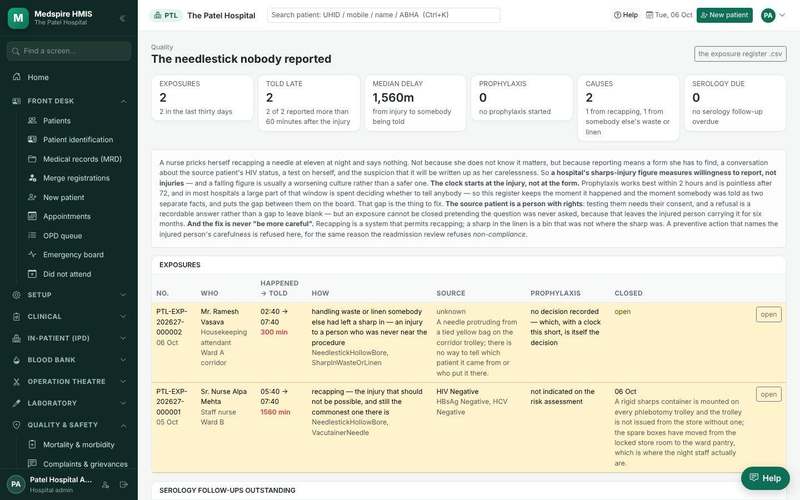
The needlestick nobody reported
A nurse pricks herself recapping a needle at eleven at night and says nothing. Not because she does not know it matters, but because reporting means a…
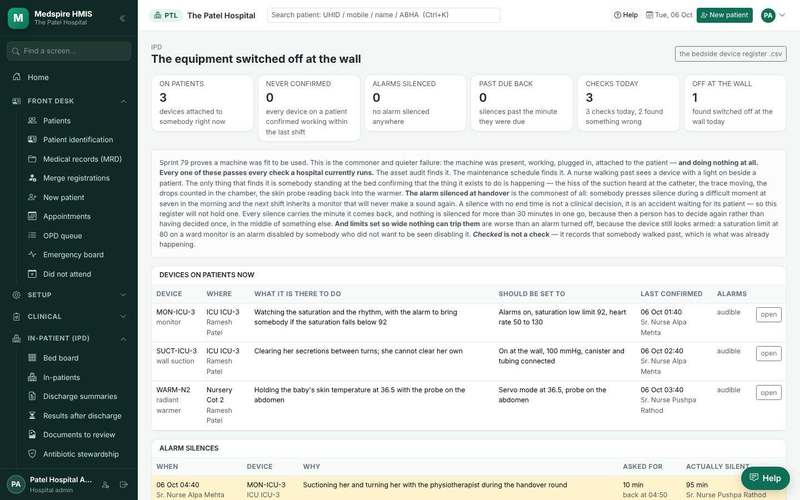
The equipment switched off at the wall
Sprint 79 proves a machine was fit to be used. This is the commoner and quieter failure: the machine was present, working, plugged in, attached to the…
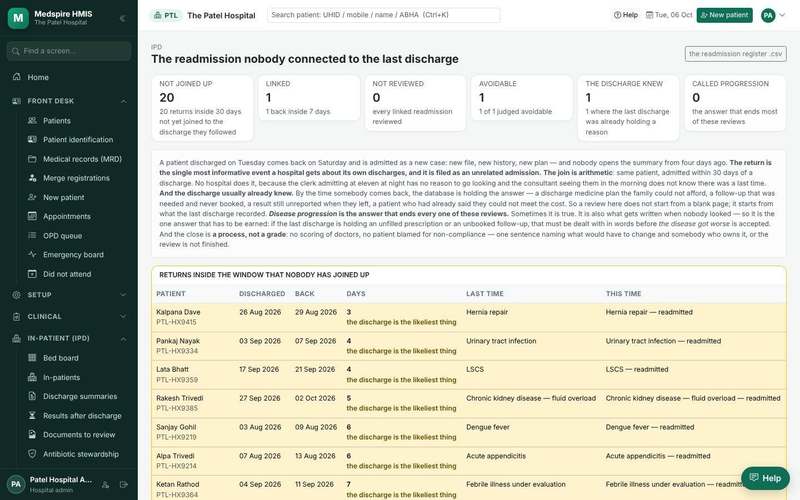
The readmission nobody connected to the last discharge
A patient discharged on Tuesday comes back on Saturday and is admitted as a new case: new file, new history, new plan — and nobody opens the summary f…
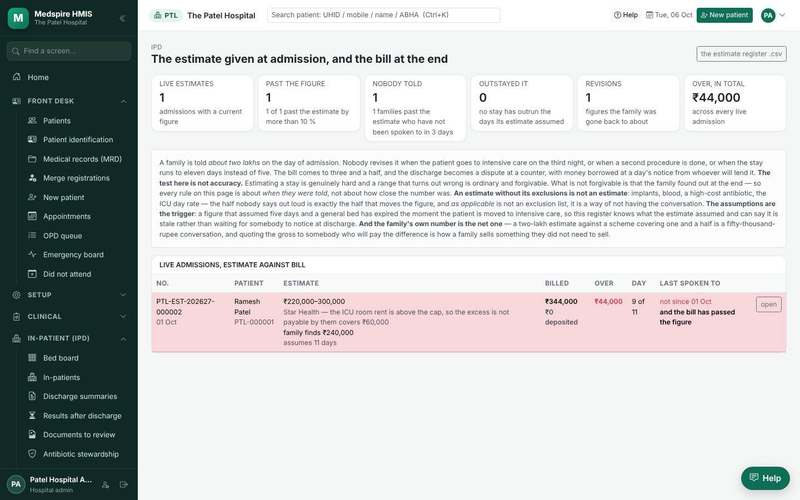
The estimate given at admission and the bill at the end
A family is told about two lakhs on the day of admission. Nobody revises it when the patient goes to intensive care on the third night, or when a seco…
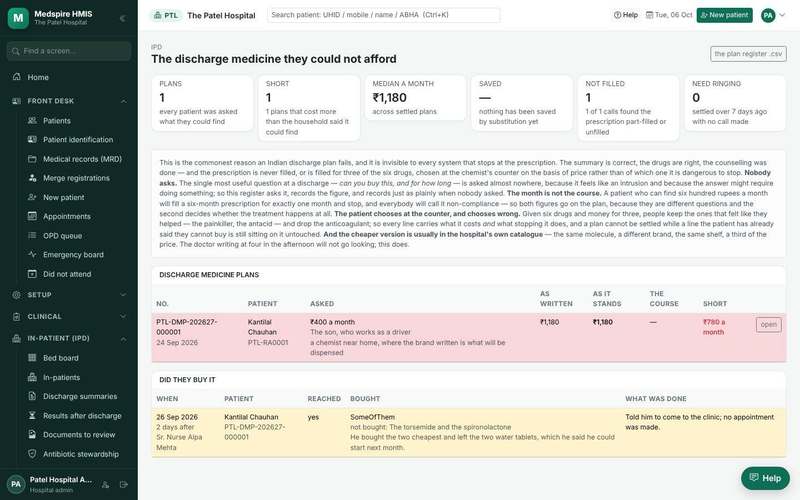
The discharge medicine they could not afford
This is the commonest reason an Indian discharge plan fails, and it is invisible to every system that stops at the prescription. The summary is correc…
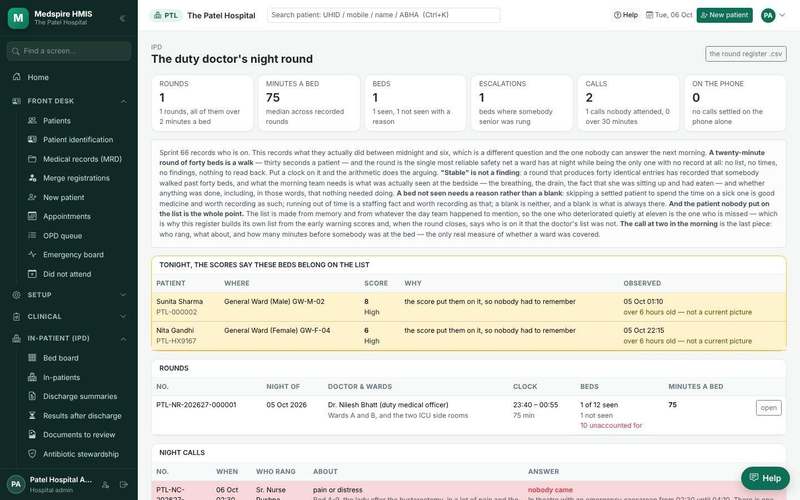
The duty doctor's night round
Sprint 66 records who is on. This records what they actually did between midnight and six, which is a different question and the one nobody can answer…
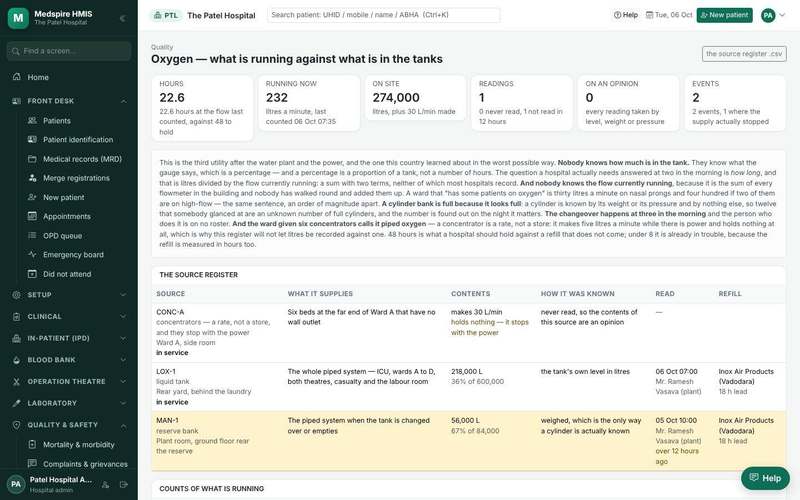
Oxygen: the manifold, the tank and the flow nobody added up
The third utility after Sprint 100's water plant and Sprint 111's power, and the one this country learned about in the worst possible way. A hospital…
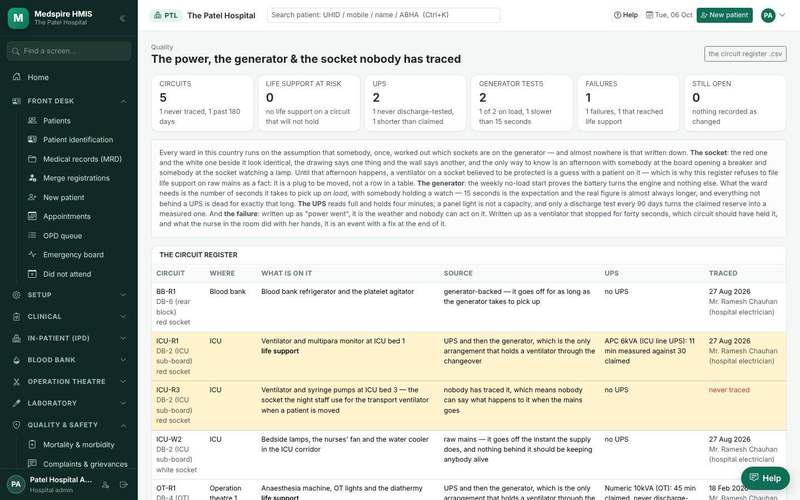
The power, the generator and the socket nobody has traced
Every ward in this country runs on the assumption that somebody, once, worked out which sockets are on the generator — and almost nowhere is that writ…
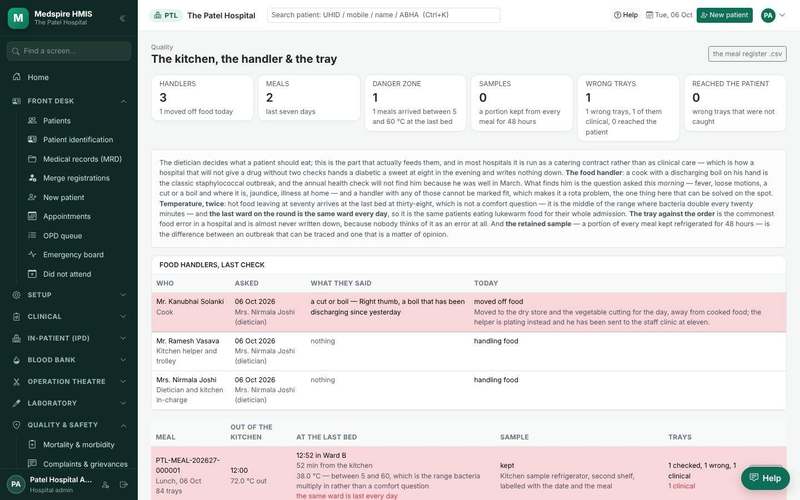
The kitchen, the food handler and the meal that reaches the bed
Sprint 41 decides what a patient should eat. This is the part that feeds them, and in most hospitals it is run as a catering contract rather than as c…
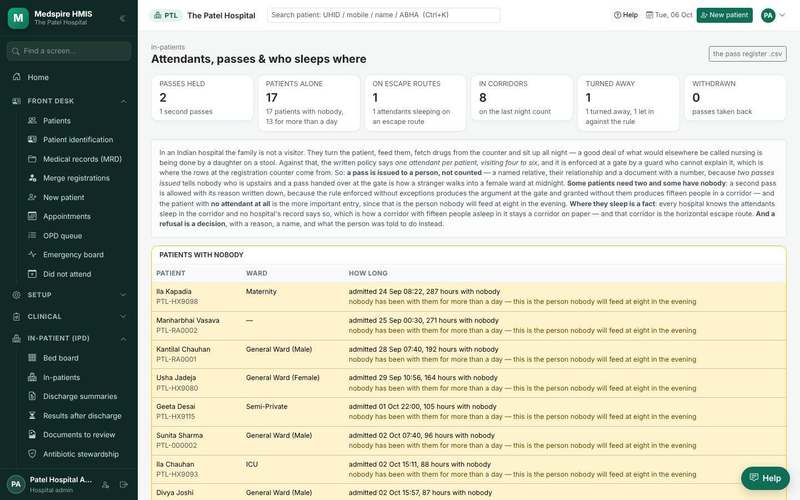
The attendant, the visitor pass and who sleeps on the floor
In an Indian hospital the family is not a visitor. They turn the patient, feed them, fetch drugs from the counter and sit up all night — a good deal o…
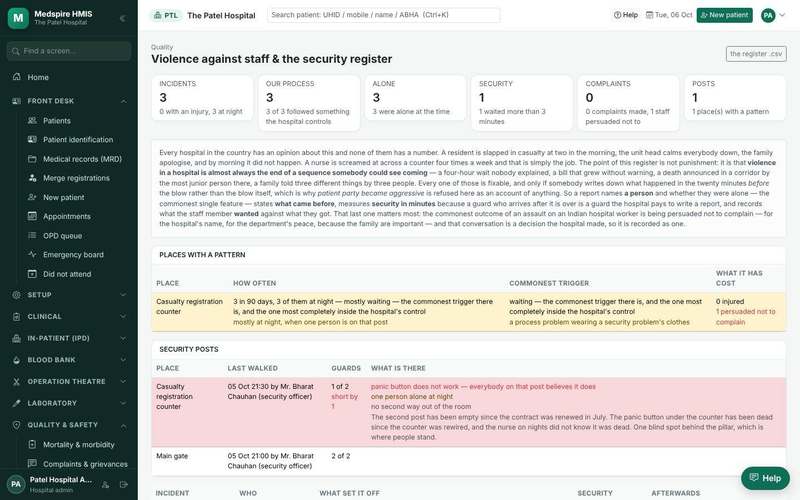
Violence against staff and the security register
Every hospital in the country has an opinion about this and none of them has a number. A resident is slapped in casualty at two in the morning, the un…
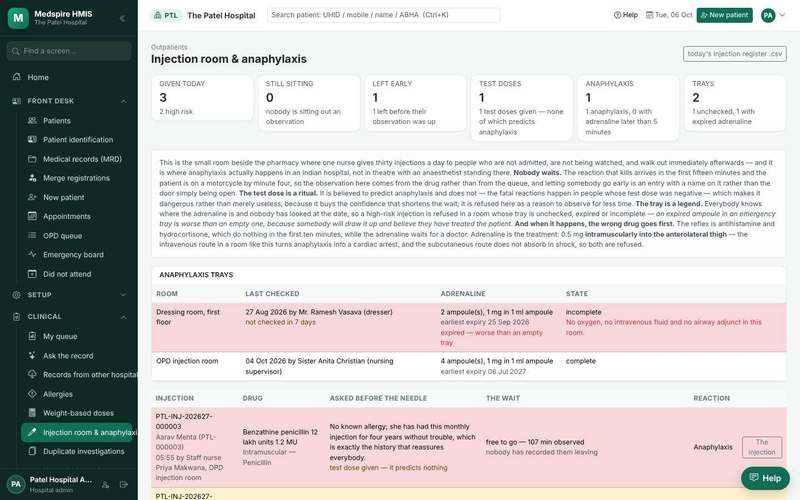
The injection room and the anaphylaxis nobody was waiting for
This is the small room beside the pharmacy where one nurse gives thirty injections a day to people who are not admitted, are not being watched, and wa…
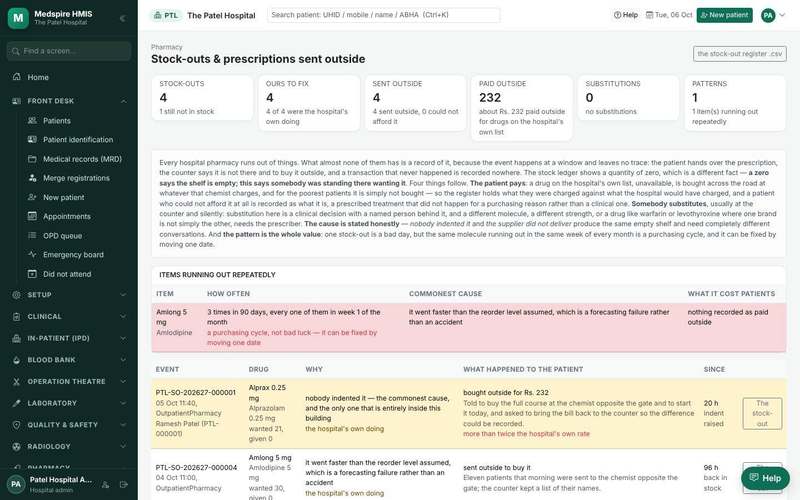
The stock-out and the prescription sent outside
Every hospital pharmacy runs out of things; almost none of them has a record of it, because the event happens at a window and leaves no trace. The pat…
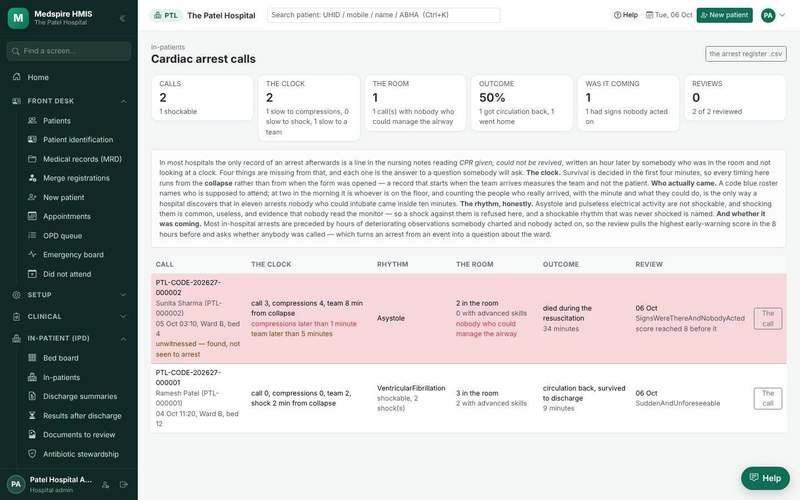
The cardiac arrest call
Sprint 94 checks that the trolley is ready and Sprint 52 scores the observations that come before. This is the event itself, and the only record of it…
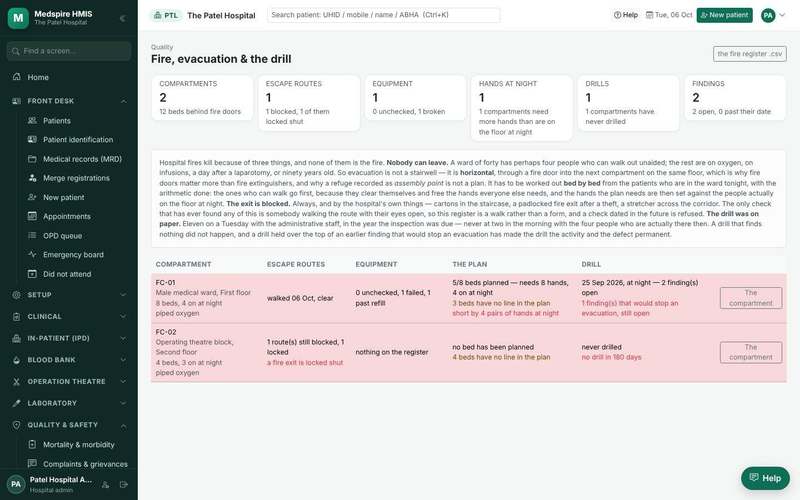
Fire, evacuation and the drill
Hospital fires kill because of three things, and none of them is the fire.
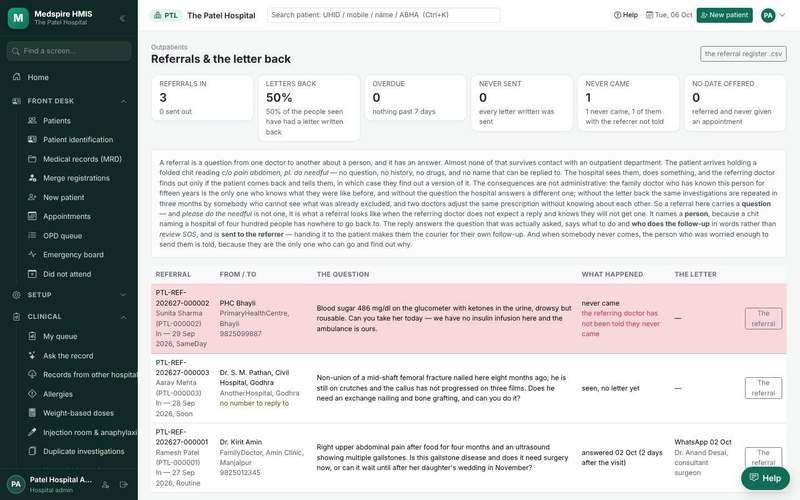
The referral and the letter back
A referral is a question from one doctor to another about a person, and it has an answer. Almost none of that survives contact with an outpatient depa…
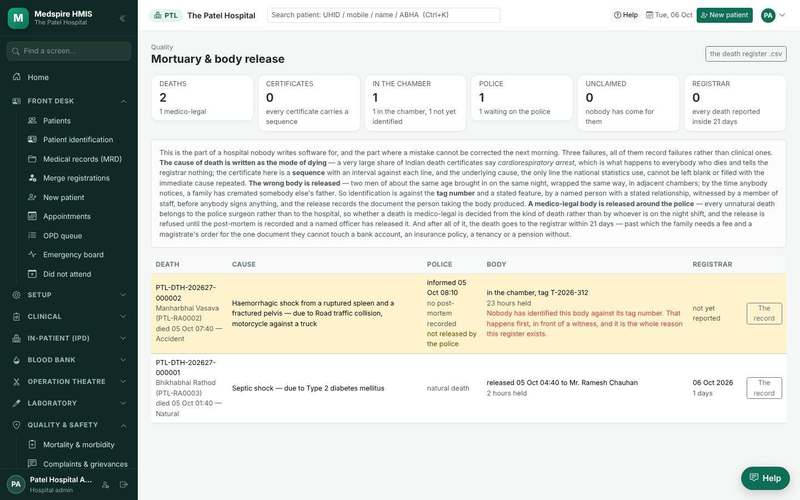
The mortuary and the body-release register
This is the part of a hospital nobody writes software for, and the part where a mistake cannot be corrected the next morning. The register by the cham…
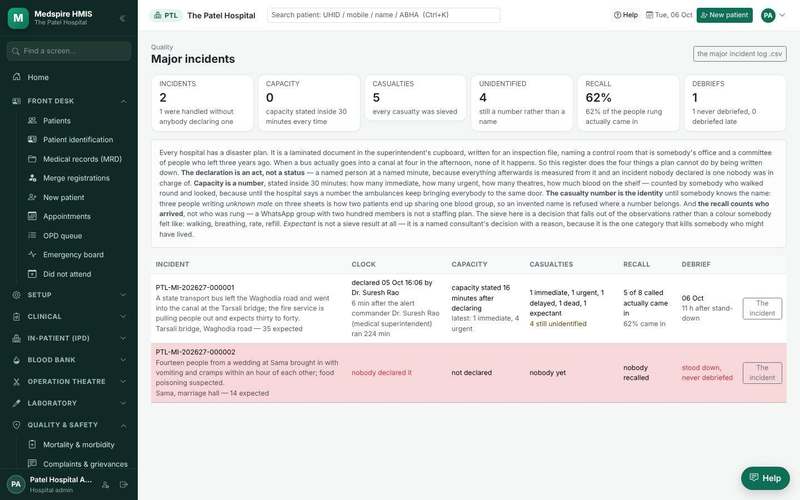
The major incident
Every hospital in India has a disaster plan. It is laminated, it is in the medical superintendent's cupboard, it was written for an inspection file, a…
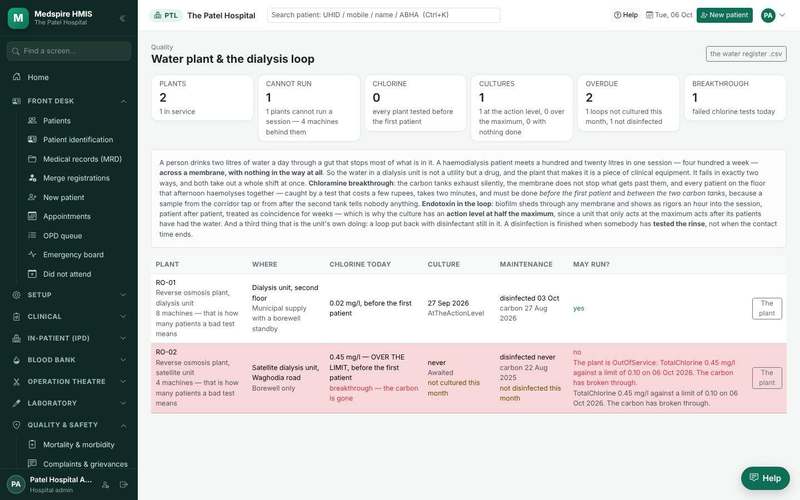
The water plant and the dialysis loop
A person drinks two litres of water a day through a gut that stops most of what is in it. A haemodialysis patient meets a hundred and twenty litres in…
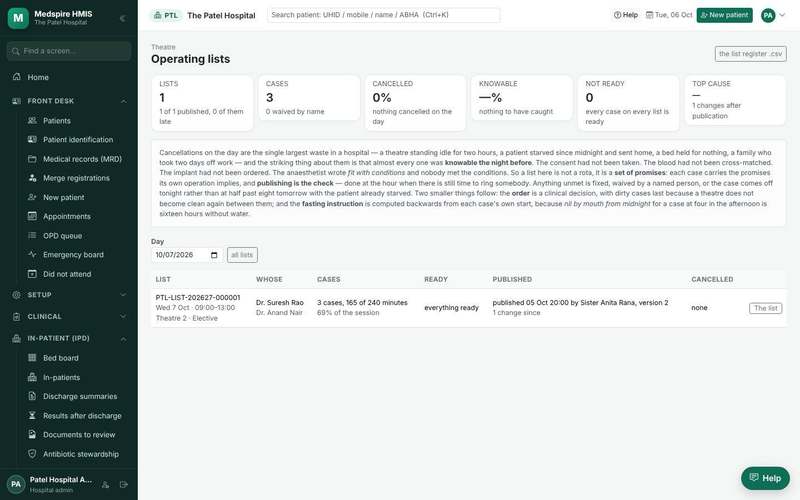
The operating list the night before
The build already measures the theatre day (58), the safety checklist (59), the counts (60) and the pre-anaesthesia assessment (70). None of them touc…
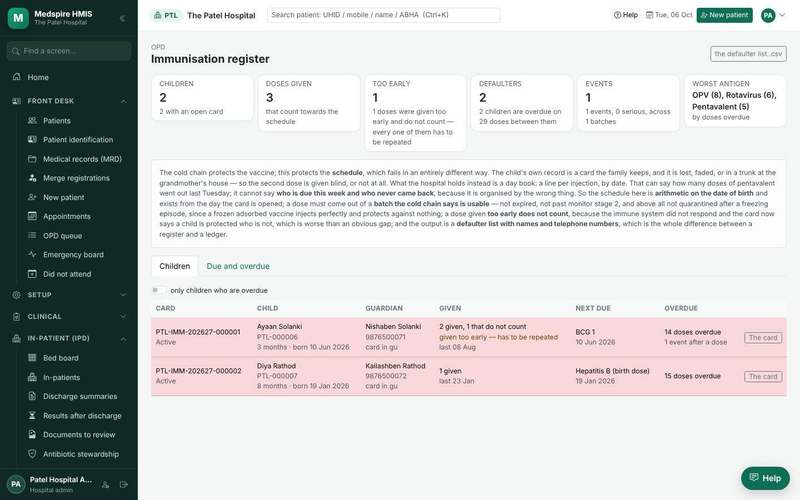
The immunisation register and the child's own card
Sprint 97 protects the vaccine; this protects the schedule, which fails differently. The child's own record is a card the family keeps, and it is lost…
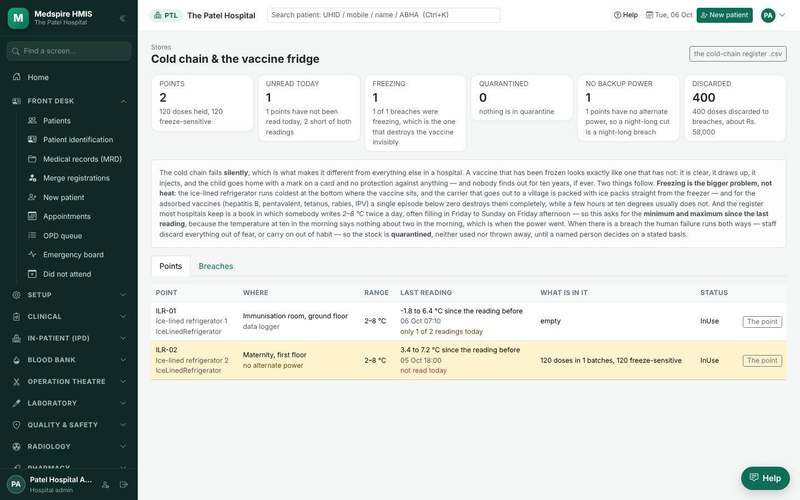
The cold chain and the vaccine fridge
The cold chain fails silently, which is what makes it unlike everything else in a hospital. A vaccine that has been frozen looks exactly like one that…
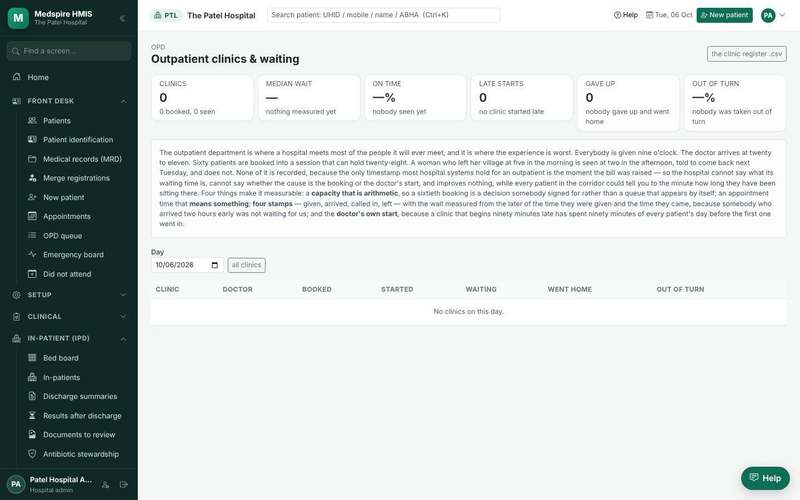
The outpatient clinic's own clock
The outpatient department is where a hospital meets most of the people it will ever meet, and it is where the experience is worst. Everybody is given…
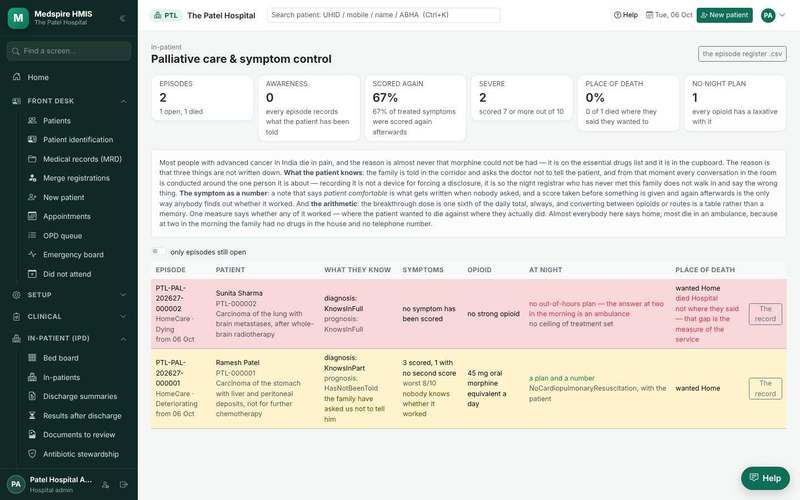
Palliative care and symptom control
Most people with advanced cancer in India die in pain, and the reason is almost never that morphine could not be had — it is on the essential drugs li…
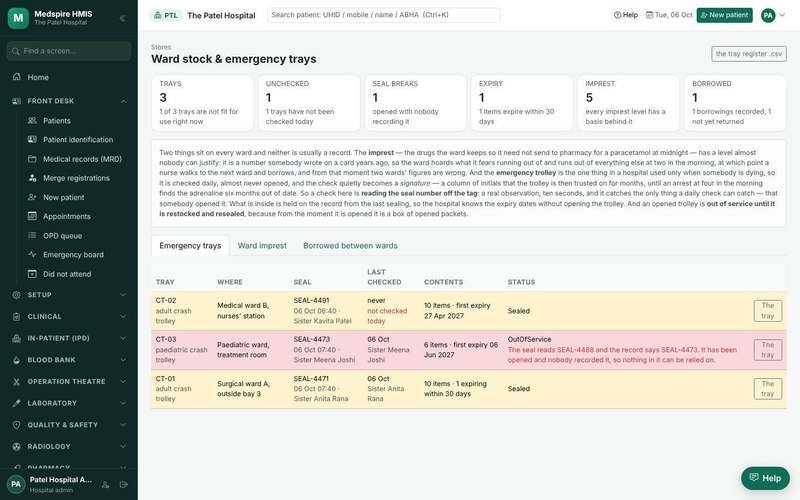
Ward imprest stock and the emergency drug tray
Two things sit on every ward and neither is usually a record. The imprest — the drugs a ward keeps so it need not send to pharmacy for a paracetamol a…
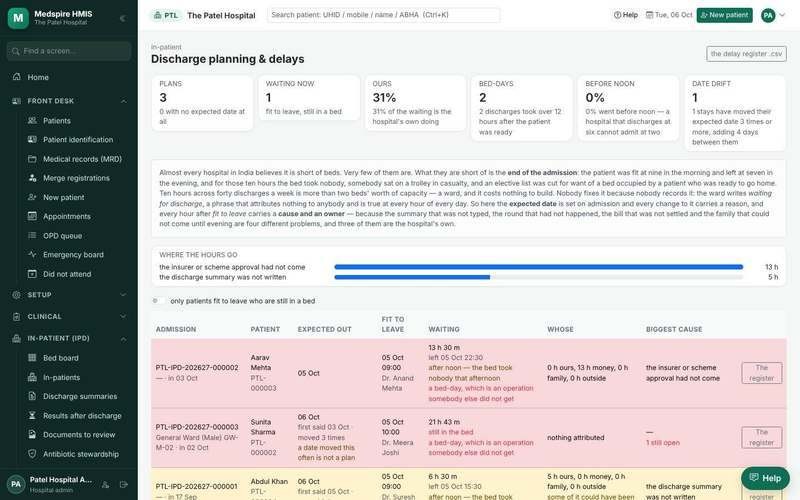
The discharge-delay register
Almost every hospital in India believes it is short of beds. Very few are. What they are short of is the end of the admission: the patient was fit at…
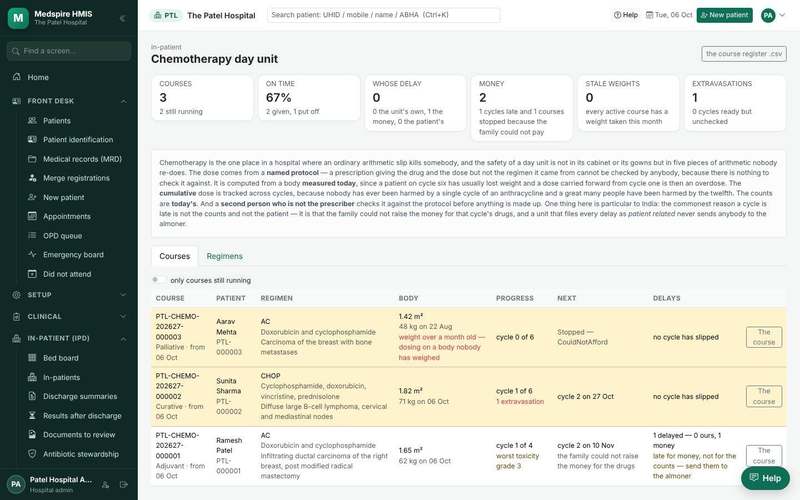
The outpatient chemotherapy day unit
Chemotherapy is the one place in a hospital where an ordinary arithmetic slip kills somebody. The drugs have no therapeutic margin worth the name — a…
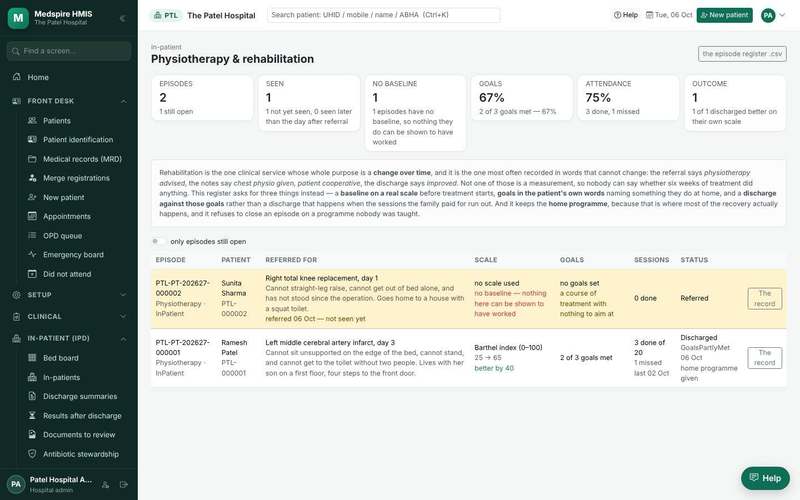
Physiotherapy and rehabilitation
Rehabilitation is the only clinical service in a hospital whose whole purpose is a change over time, and it is the one most often recorded in words th…
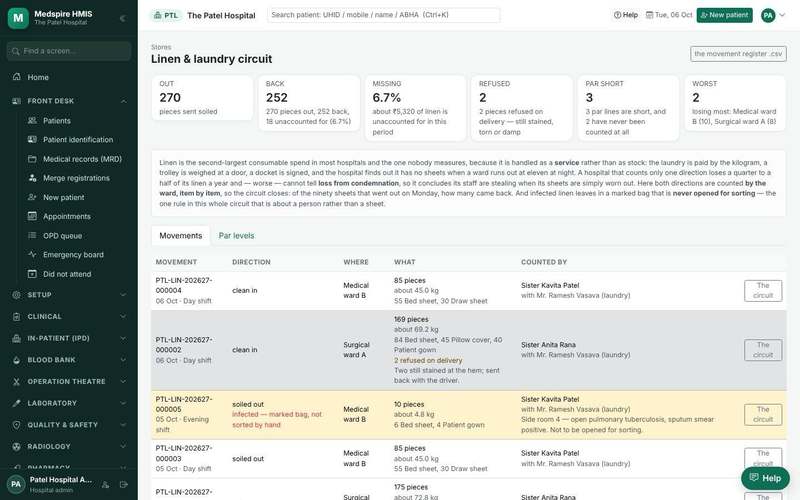
The linen and laundry circuit
Linen is the second-largest consumable spend in most hospitals and the one nobody measures, because it is handled as a service rather than as stock. T…
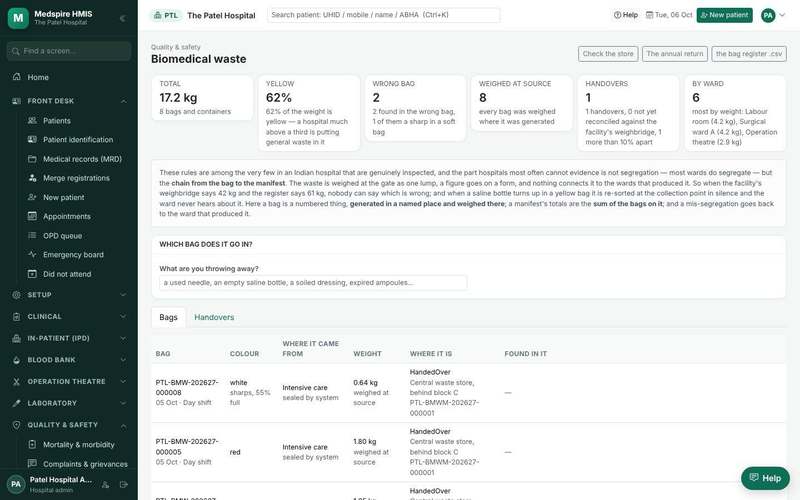
Biomedical waste, from the bag to the manifest
These rules are among the very few in an Indian hospital that are genuinely inspected. What hospitals most often cannot evidence is not segregation —…
Medical records and the movement of the case file
The electronic record has been in this build since Sprint 1 and the paper has not gone anywhere: the consent forms with signatures on them, the anaest…
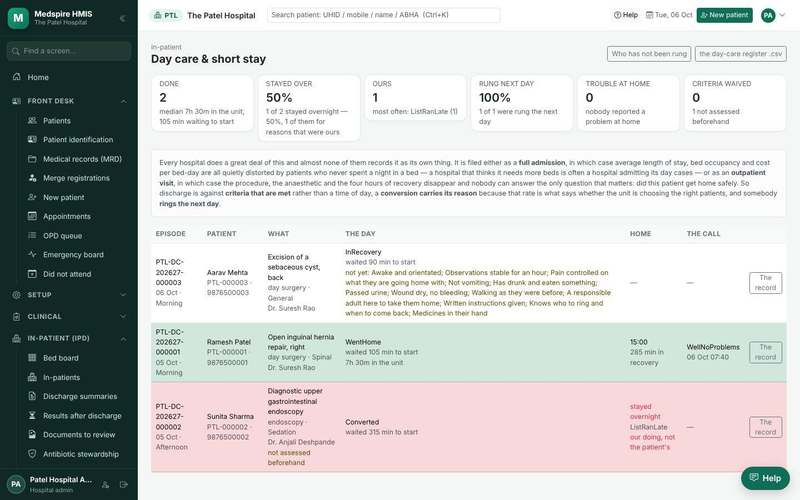
The day-care and short-stay pathway
Every hospital does a great deal of this and almost none of them records it as its own thing. It is filed one of two ways, and both are wrong. As a fu…
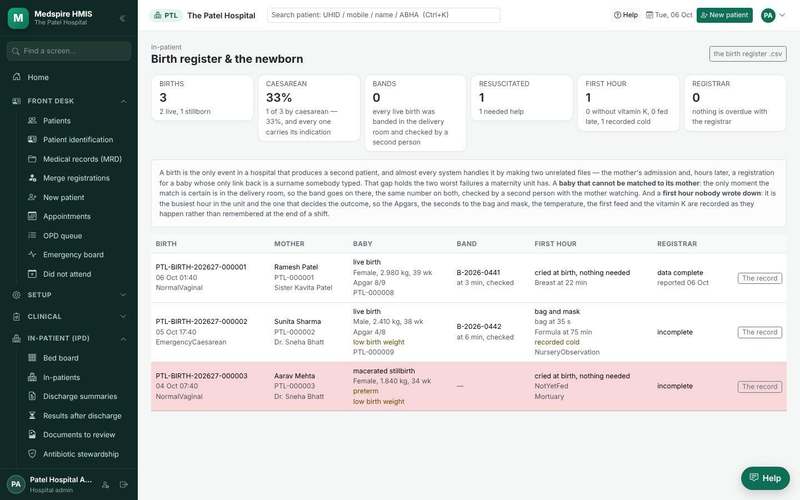
The birth and the newborn record
A birth is the only event in a hospital that produces a second patient. Almost every system in the country handles it by making two unrelated files —…
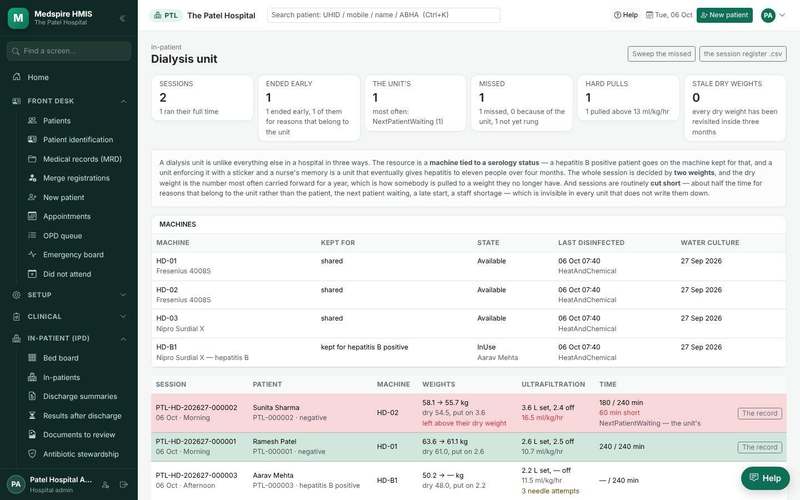
The dialysis unit
A dialysis unit is unlike the rest of a hospital in three ways, and all three are why the ordinary scheduling and orders machinery does not fit it.
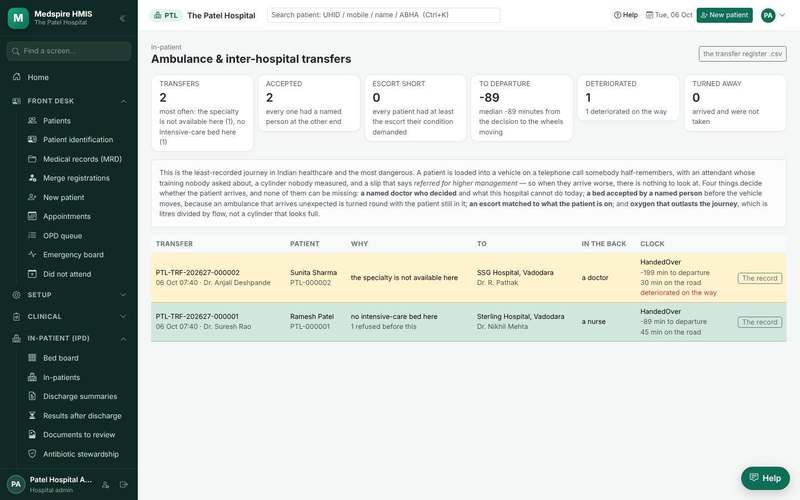
The ambulance and the inter-hospital transfer
This is the least-recorded journey in Indian healthcare and the most dangerous. A patient is loaded into a vehicle on a telephone call somebody half-r…
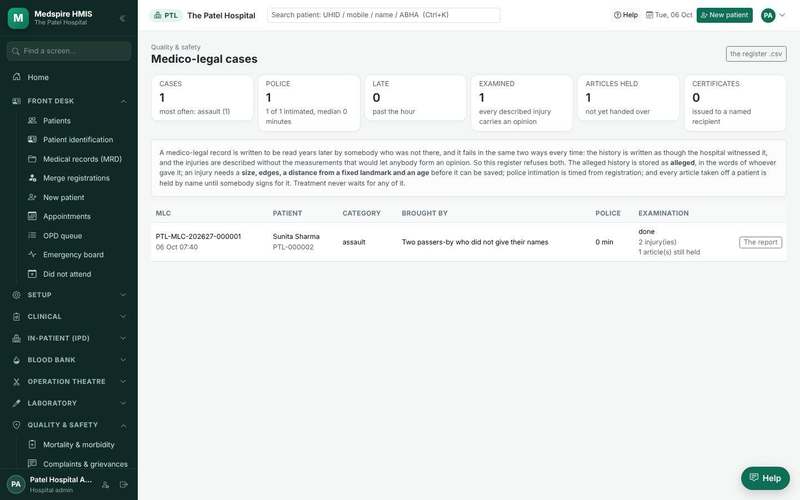
The medico-legal register
A medico-legal record is written to be read years later by somebody who was not there, and it fails in the same two ways every time: the history is wr…
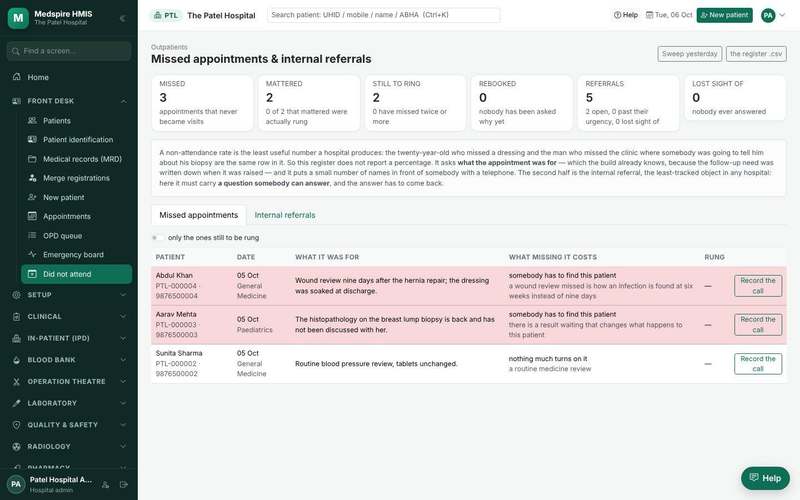
The appointment that never becomes a visit, and the referral nobody tracks
A non-attendance rate is the least useful number a hospital produces. The twenty-year-old who missed a dressing and the man who missed the clinic wher…
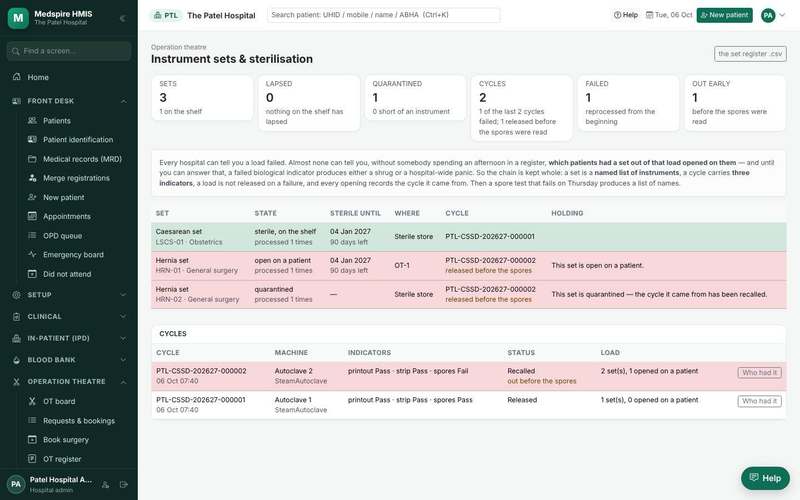
Instrument sets through sterilisation
Every hospital can tell you a load failed. Almost none can tell you, without somebody spending an afternoon in a register, which patients had a set ou…
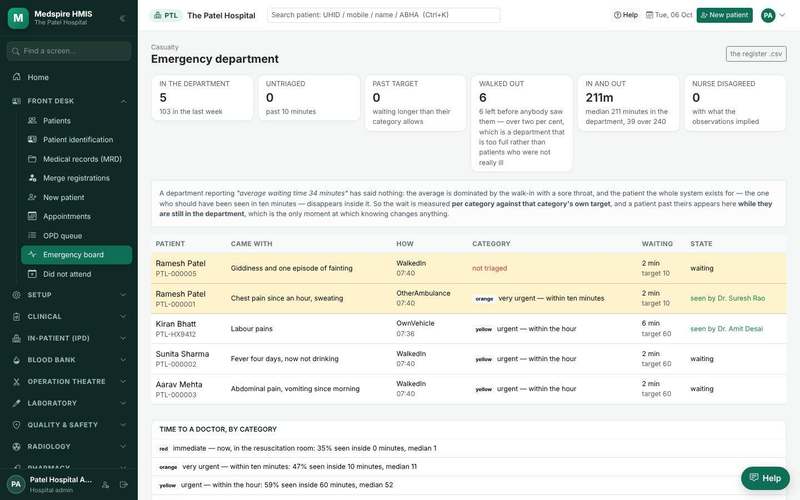
The emergency department's triage and its clock
A department reporting average waiting time 34 minutes has said nothing. The average is dominated by the walk-in with a sore throat, and the patient t…
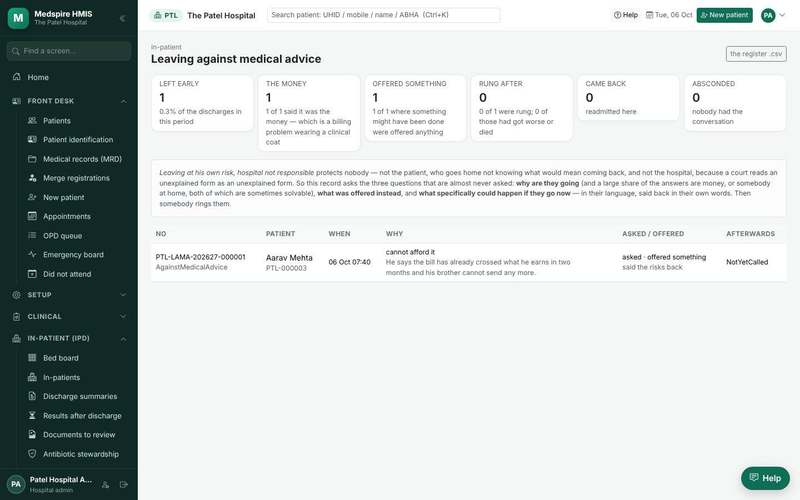
Leaving against medical advice
In an Indian hospital this is a signature on a printed line, collected at the counter, usually in English, from somebody who has already decided. It f…
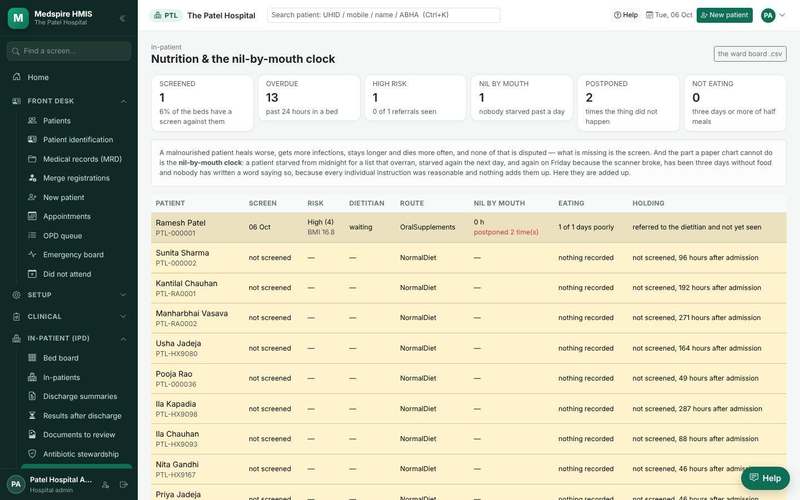
Nutrition screening and the nil-by-mouth clock
A malnourished patient heals worse, gets more infections, stays longer and dies more often. None of it is disputed and almost no ward does the screen.
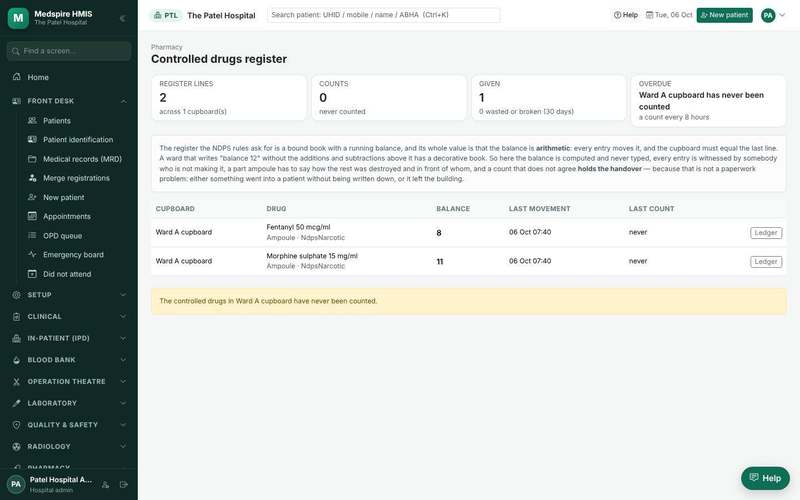
The controlled drugs cupboard
The NDPS register is a running balance and its whole value is that the balance is arithmetic. Wards keep it as a book in which somebody writes the bal…
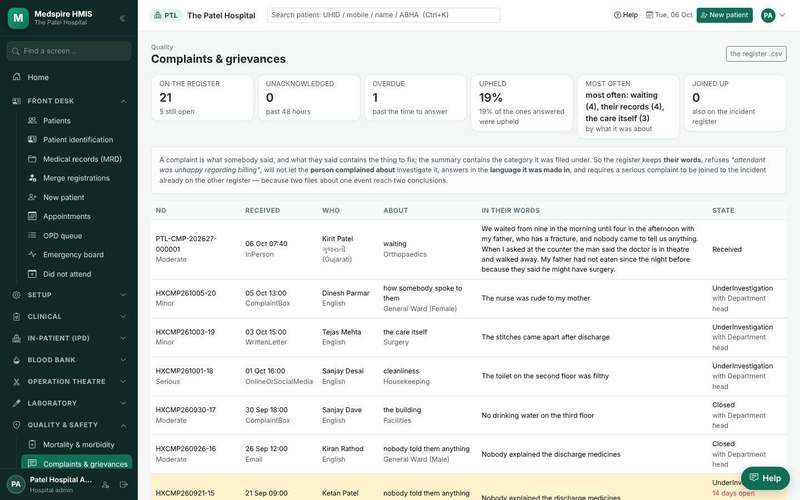
Complaints and grievances, joined to the incidents
Almost every complaint register is written in the hospital's voice, and the translation is where the information dies: "attendant was unhappy regardin…
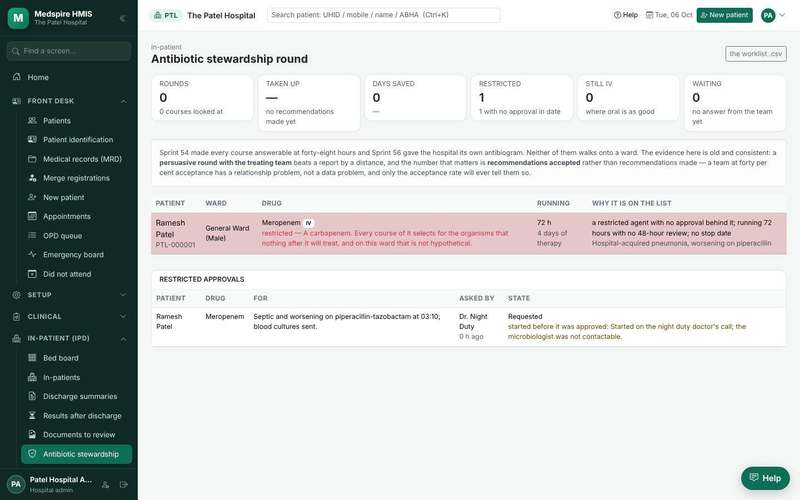
The antibiotic stewardship ward round
Sprint 54 made every course answerable at forty-eight hours; Sprint 56 gave the hospital its own antibiogram. Neither walks onto a ward, and the liter…
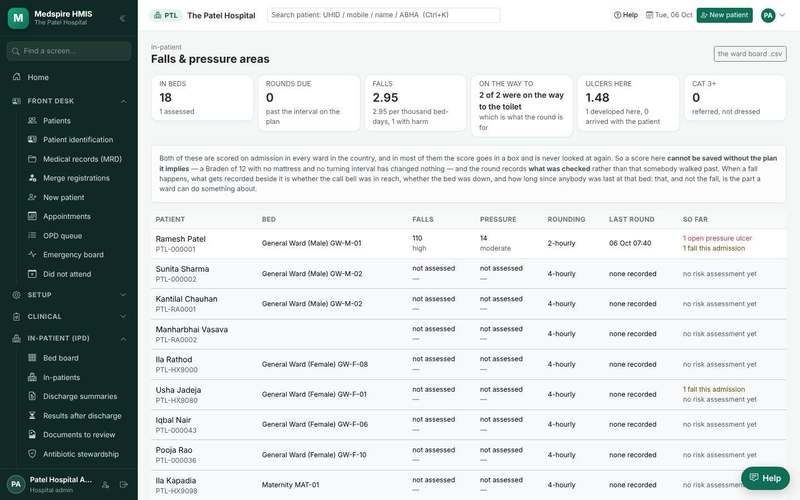
Falls and pressure ulcers, joined to the nursing round
Both harms happen to patients who are otherwise getting better, both are scored on admission everywhere, and in most wards the score goes into a box a…
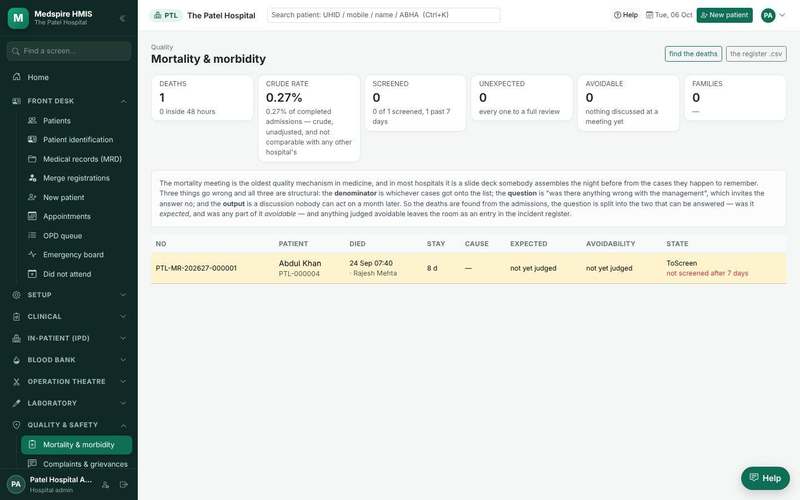
The mortality and morbidity meeting
The mortality meeting is the oldest quality mechanism in medicine and in most hospitals it is a slide deck assembled the night before, from the cases…
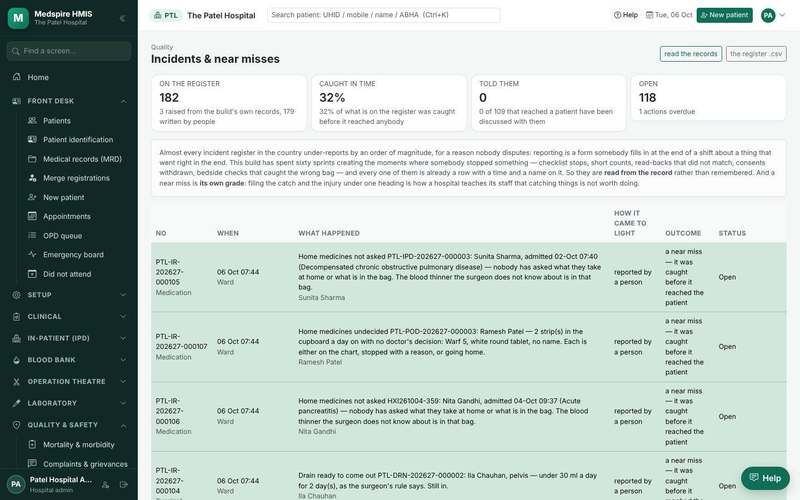
The incident and near-miss register that the interlocks feed
Almost every incident register in the country under-reports by an order of magnitude, and nobody disputes the reason: reporting is a form somebody fil…
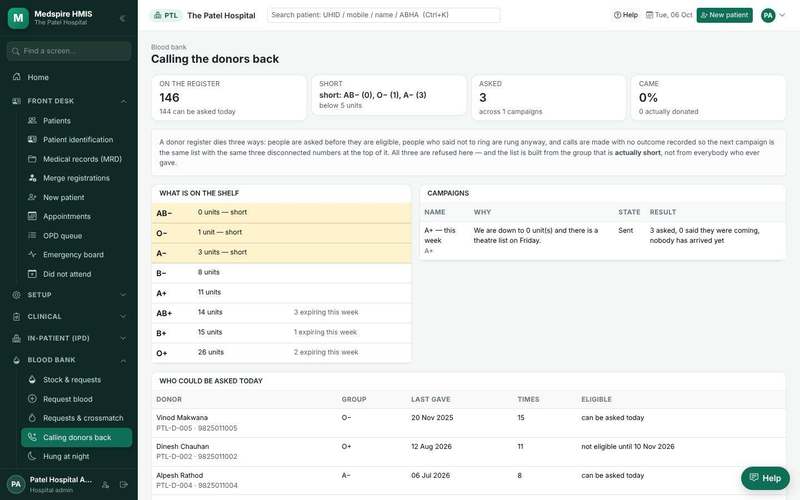
Calling the donors back
Sprint 33 built the camps and the monthly return, and what it produced was a register — several hundred people who gave once and were never contacted…
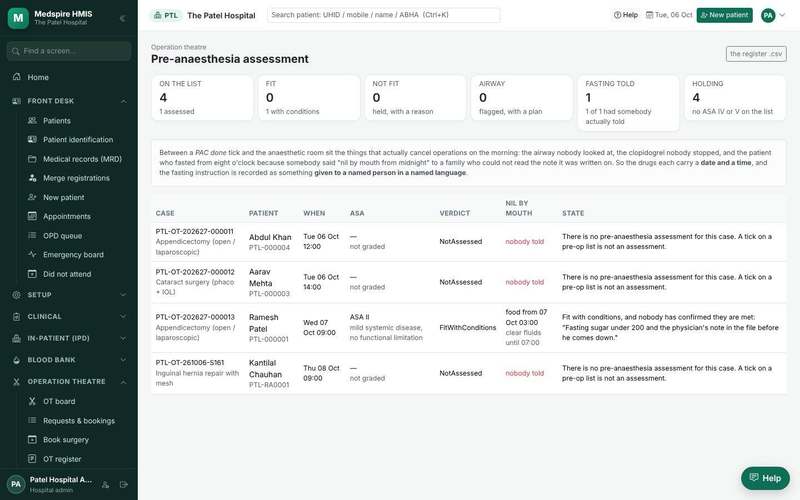
The pre-anaesthesia assessment as an interlock
Sprint 9 has a PacDone tick and an ASA grade typed into a box. Between that tick and the anaesthetic room sit the airway nobody looked at, the clopido…
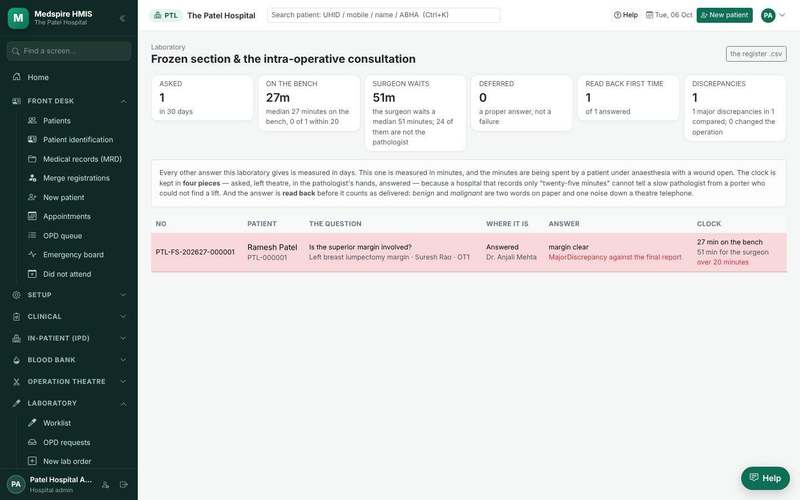
The frozen section and the intra-operative consultation
Every other answer this laboratory gives is measured in days. This one is measured in minutes and the minutes belong to a patient with an open wound.…
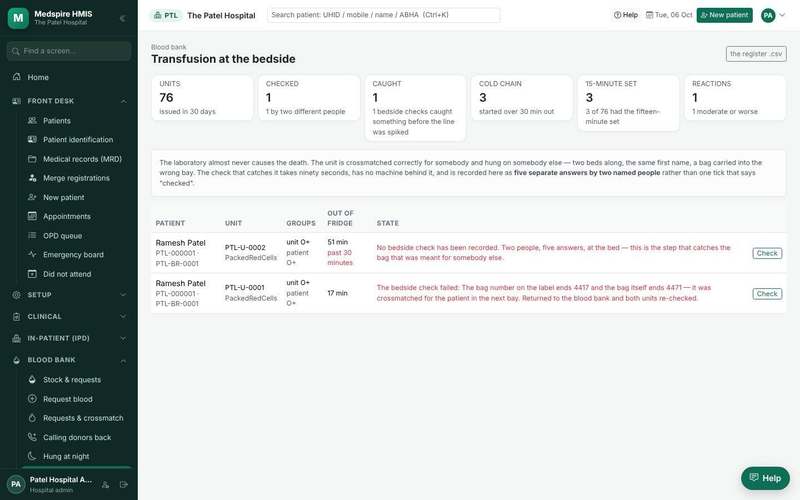
Blood transfusion, from the request to the vein
Sprint 19 stops at the door of the fridge, and everything that kills a patient happens after that door. Almost every fatal transfusion reaction on rec…
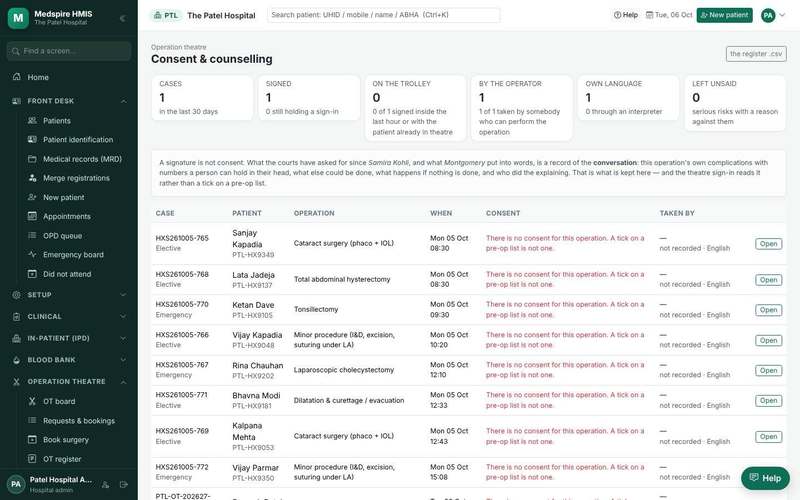
The counselling and consent record before an operation
Sprint 9 stores a ConsentSigned tick and the sign-in confirms it. That tick is what every hospital in the country has, and it is what every consent ca…
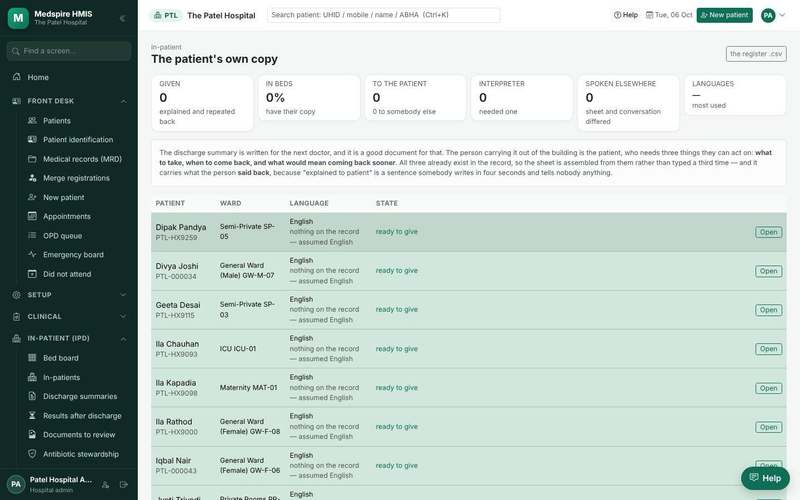
The patient's own copy of what they were told
Sprint 64 settled which medicines carry on and Sprint 65 settled when the patient comes back — and both of them live inside the hospital's own documen…
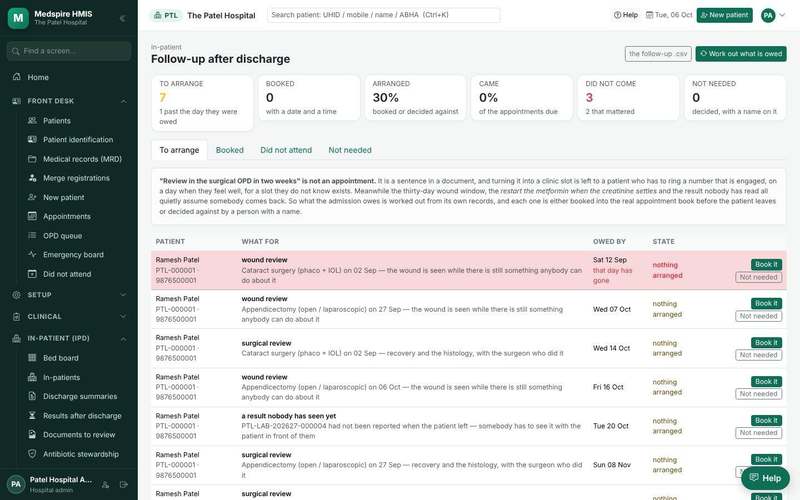
The follow-up actually booked before the patient leaves
"Review in the surgical OPD in two weeks" is not an appointment. It is a sentence, and turning it into a clinic slot is left to the patient: ring a nu…
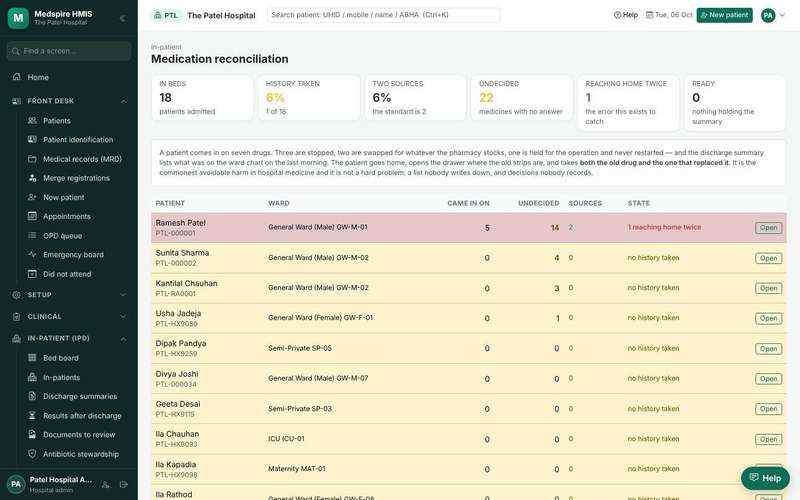
Discharge medication reconciliation
A patient arrives on seven drugs. Three are stopped, two are swapped for the hospital's formulary equivalents, one is held for theatre and never resta…
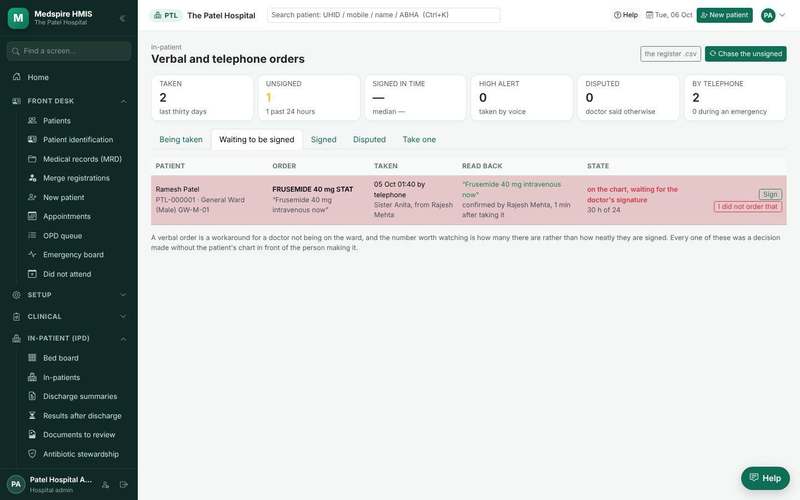
Verbal and telephone orders, with the read-back going the other way
Sprint 62 makes the laboratory prove a critical value was heard correctly. The same conversation happens all night in the opposite direction and nobod…
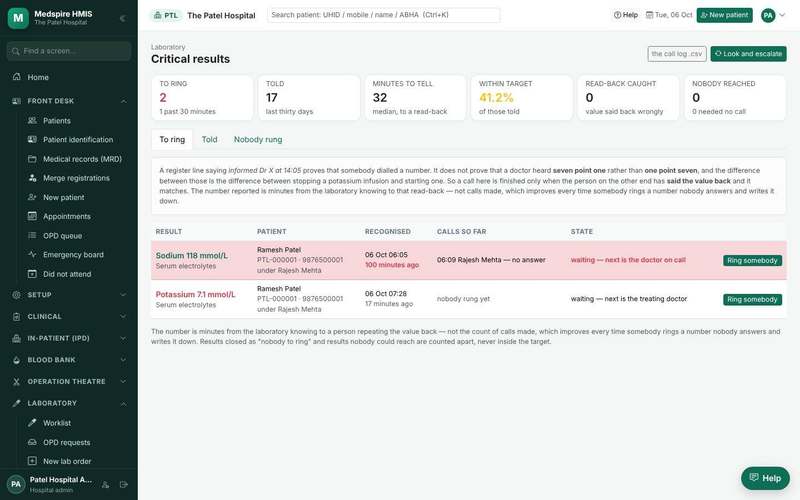
The critical-result telephone call and its read-back
Sprint 45 chases results that arrive after discharge and Sprint 46 messages the treating doctor when one lands. Neither helps with a potassium of 7.1.…
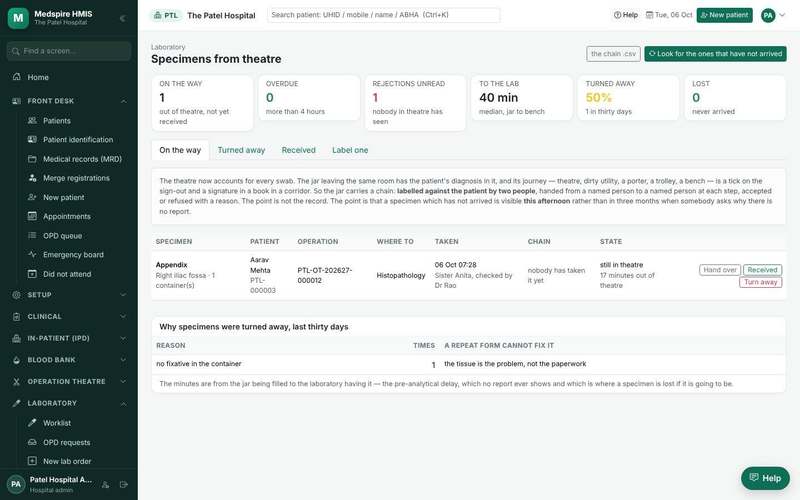
The specimen's journey from theatre to the laboratory
Sprint 60 makes a theatre account for every swab. The jar leaving the same room has the patient's diagnosis in it, and its journey is one tick on the…
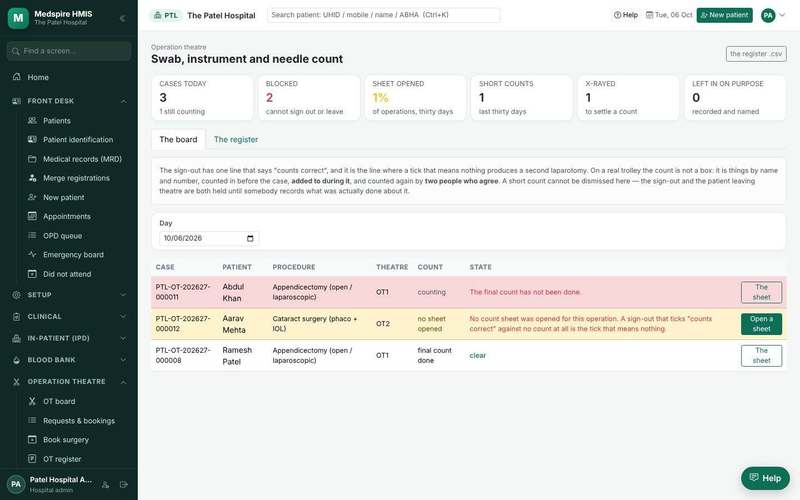
The swab, instrument and needle count as an interlock
Sprint 59 made the sign-out honest about when it happened. Its counts line is still a single tick-box, and it is the one line where a tick that means…
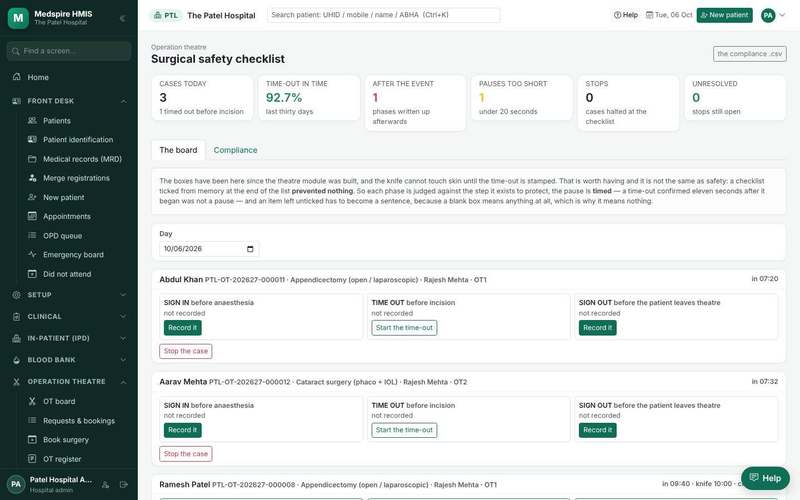
The surgical safety checklist as a measured record
Sprint 9 already stores all seventeen boxes and refuses an incision until the time-out is stamped. That is worth having and it is not safety. A checkl…
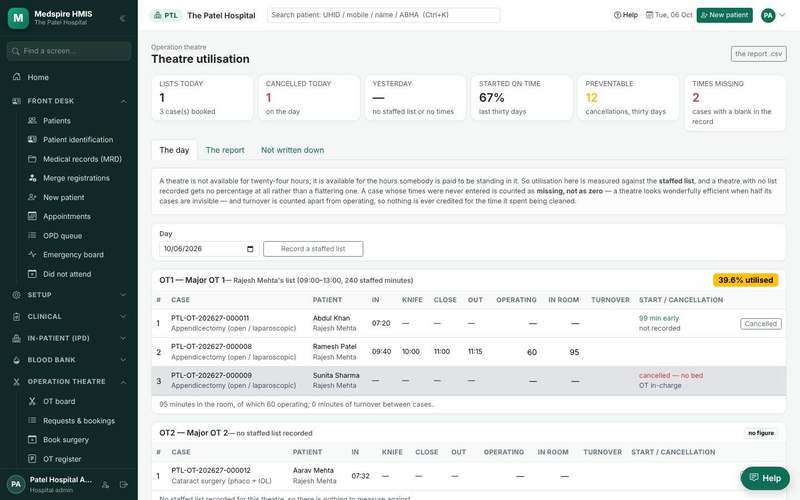
Theatre utilisation and the start-time record
The theatre is the most expensive room in the hospital and the one nobody can say anything factual about. Sprint 9 already records in-theatre, knife t…
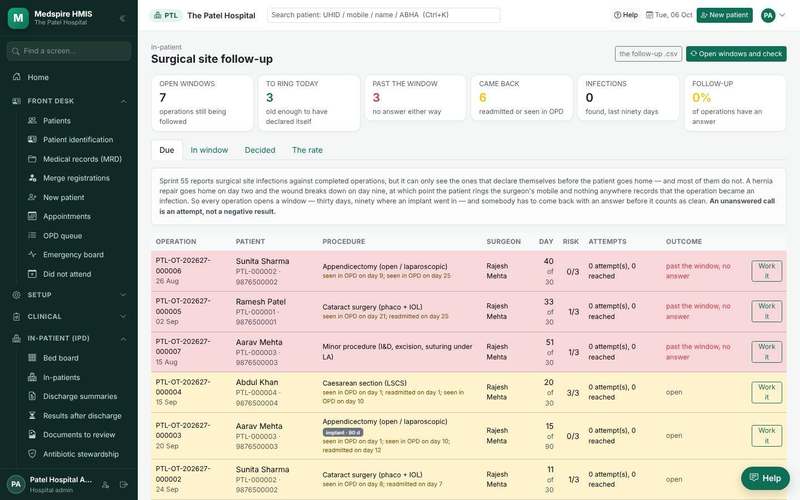
The thirty-day surgical-site infection follow-up
Sprint 55 reports SSI against completed operations, but it can only see an infection that declares itself before the patient goes home — and most of t…
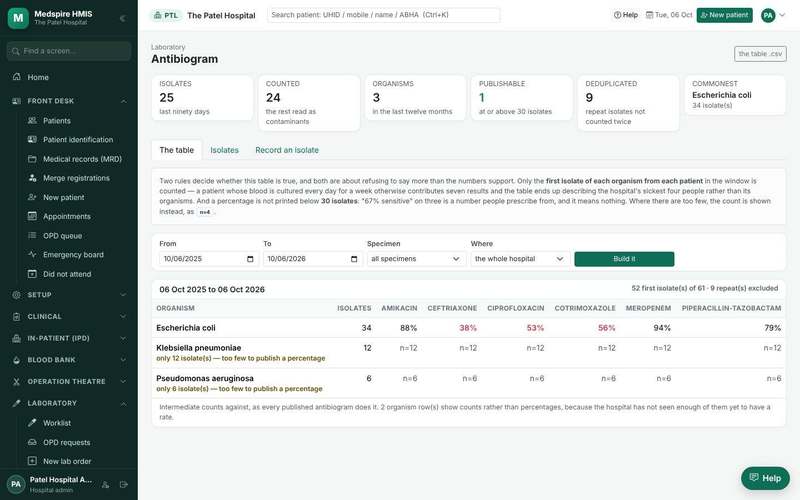
The hospital's own antibiogram
Sprint 54 asks a doctor to narrow the antibiotic and Sprint 55 makes them look at the culture. Neither answers the question that actually decides the…
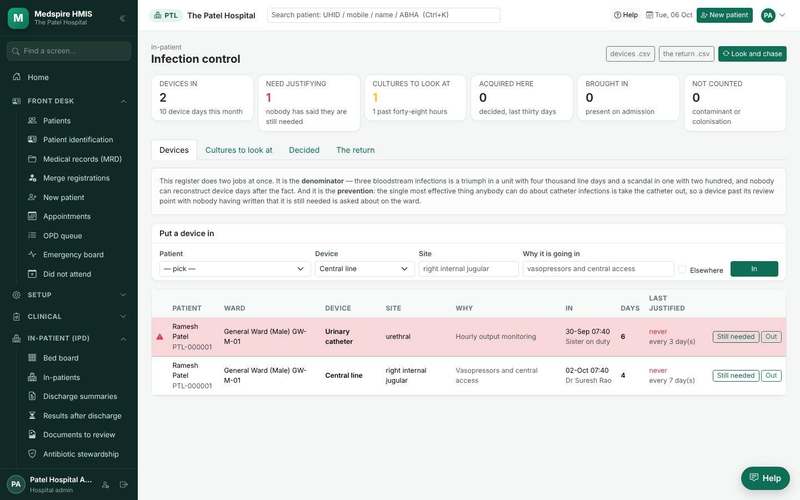
Hospital-acquired infection surveillance
Every Indian hospital seeking accreditation has to report infection rates, and almost none can produce them without a clerk and a spreadsheet — becaus…
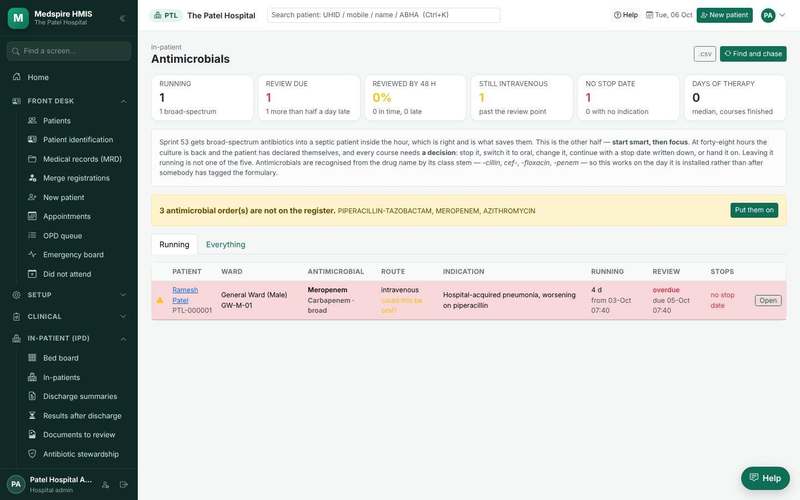
The 48-hour antimicrobial review
Sprint 53 gets broad-spectrum antibiotics into a septic patient inside the hour. That is right, and it is what saves them. What nobody does is go back…
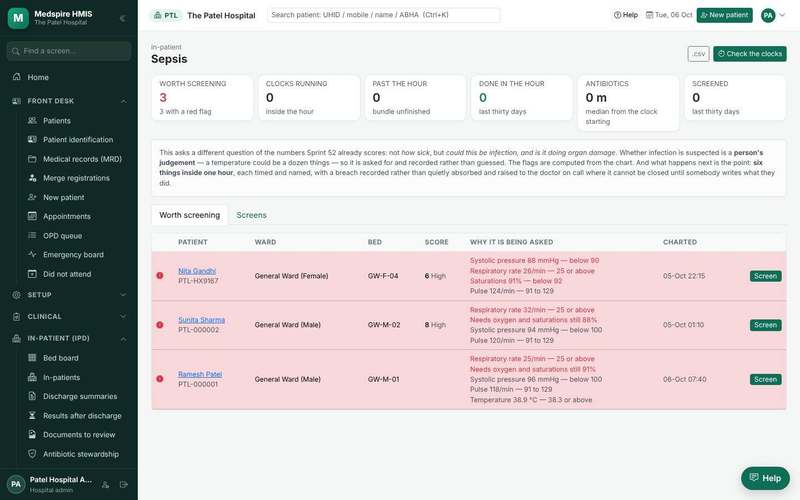
The sepsis screen, and the hour that follows it
Sprint 52's score says a patient is deteriorating. Sepsis is the cause with a clock on it, and it is a different question asked of the same numbers: n…
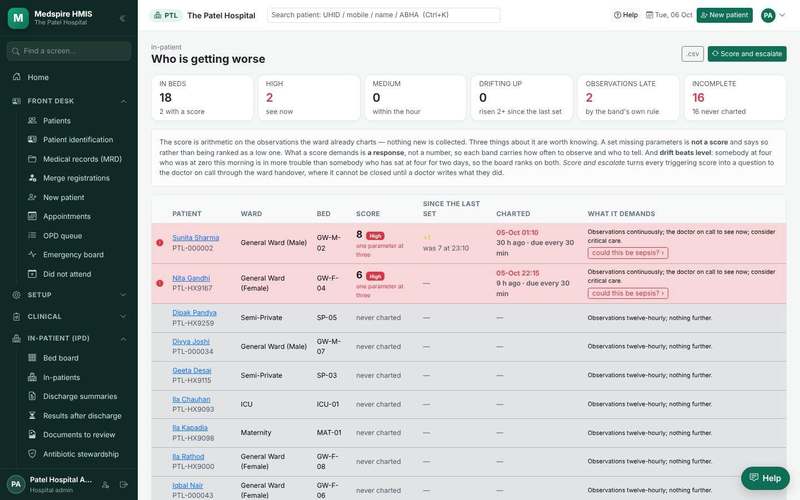
An early-warning score off the observations already charted
Sprint 51 catches the concern a nurse decides to write down. This catches the other patient: the one whose respiratory rate went from 16 to 18 to 22 t…
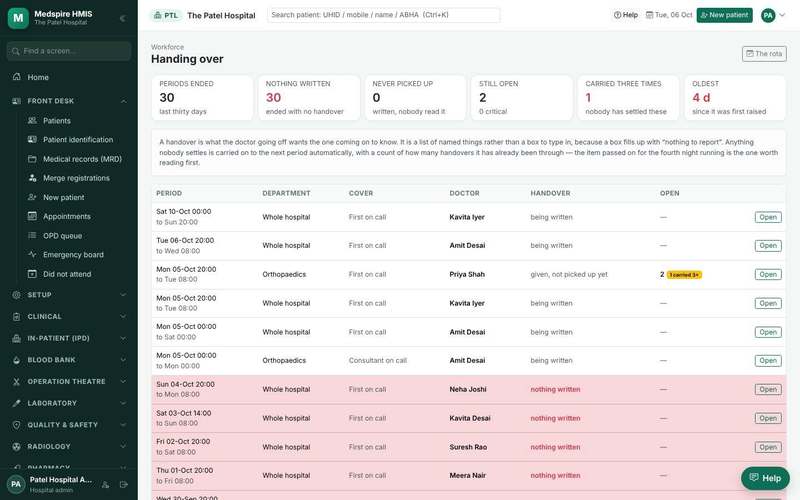
The on-call handover
Sprint 49 tells the incoming doctor that their period is starting. It cannot tell them the thing that matters: what the outgoing doctor was worried ab…
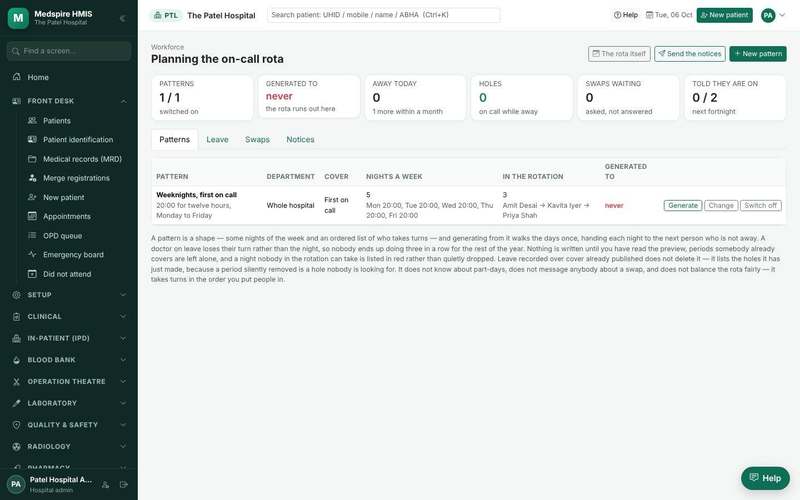
Telling people before the on-call rota fails
Sprints 47 and 48 built a rota that can be entered, generated, audited, covered for leave and swapped. Every warning it produces — the gaps tab, the o…
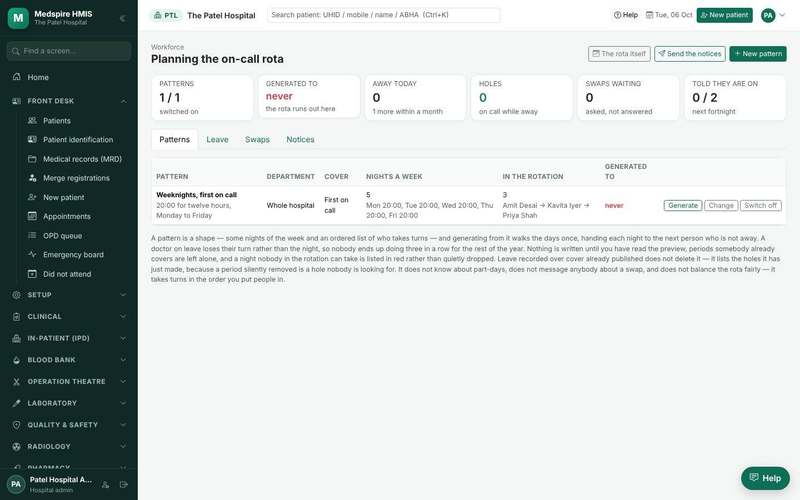
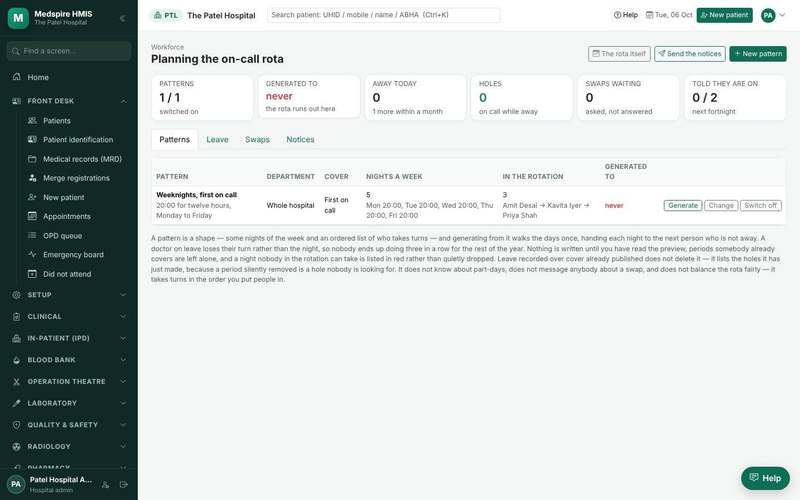
Patterns, leave and swaps on the on-call rota
Sprint 47 built a rota that can be entered and audited. Nobody enters a rota period by period for a year. In practice it gets entered for a fortnight,…
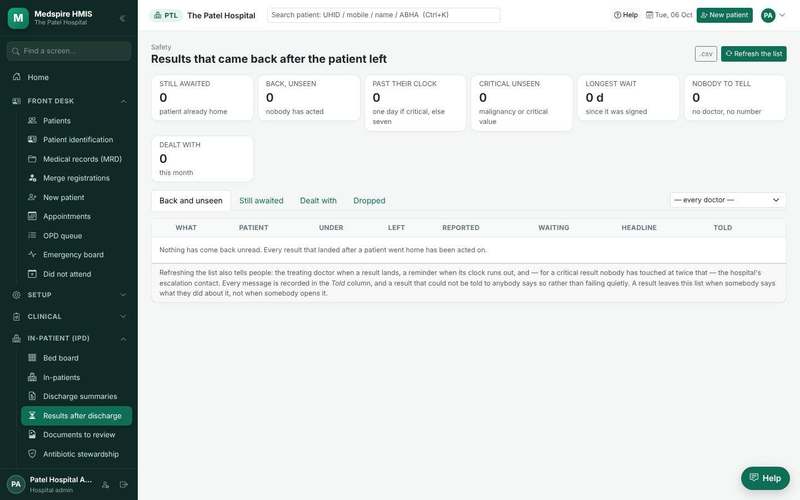
Telling somebody the result landed
Sprint 45 built the list. A list only helps whoever remembers to open it, and the person who remembers is rarely the person whose patient it is. So re…